
Why Florida Has More 55+ Communities Than Anywhere Else
Luana B. Gann, Editor
7/6/2026


Why Florida Has More 55+ Communities Than Anywhere Else
Quick Answer: Florida leads the nation in age-restricted 55+ communities because of a perfect convergence of factors: a 1995 federal law that made age-restricted housing legally viable nationwide, decades of retiree migration driven by no state income tax and warm weather, and Florida-based developers — most famously The Villages — who turned retirement living into a genuine lifestyle industry. What started as a fringe housing experiment in 1950s Arizona became one of Florida's defining residential categories, and the state now hosts some of the largest age-restricted communities on Earth.
In This Article
It Started in Arizona, Not Florida
The Villages: From Mobile Home Park to a City Bigger Than Manhattan
It Started in Arizona, Not Florida
Here's a surprise for anyone who assumes Florida invented the age-restricted community: it didn't. The very first age-restricted community in the United States was Youngtown, Arizona, established in 1954 — a small, unincorporated experiment in restricting residency to older adults that nobody at the time expected to become a national housing category.
The concept exploded into the mainstream in 1960, when developer Del Webb opened Sun City, Arizona — a fully master-planned, age-restricted community with golf courses, recreation centers, and a genuinely new pitch to American retirees: that retirement could be an active, social, amenity-rich lifestyle rather than simply the end of working life. Sun City was a sensation, and it established the model that would eventually reshape huge portions of Florida's residential landscape.
According to a detailed history compiled by 55places.com, the 55+ community concept proved remarkably resilient through subsequent decades — including surviving the 2008 housing crash largely intact, a testament to just how durable the demand for this specific kind of retirement housing turned out to be.
🏌️ Sun City's Big Idea Del Webb's genuine innovation wasn't just restricting a neighborhood by age — it was reframing retirement itself as an aspirational lifestyle stage, complete with its own amenities, social calendar, and identity. That single marketing and design insight is the direct ancestor of everything from golf-cart culture to resident clubs that define Florida's modern 55+ communities.
The Federal Law That Made It All Legal: HOPA
Age-restricted housing existed in a genuinely uncertain legal space for decades — because on its face, refusing to rent or sell a home to someone based on age (or barring their children from living there) runs directly into federal fair housing protections. That changed in 1995 with the Housing for Older Persons Act (HOPA), a federal law that created a specific, defined exemption allowing communities to legally restrict residency by age, provided they meet clear criteria.
Under HOPA, a community qualifies as legitimate "housing for older persons" — and can lawfully deny residency to families with children — if it meets three core requirements, according to the Florida Commission on Human Relations:
At least 80% of occupied units must have at least one resident aged 55 or older.
The community must have published policies and procedures that clearly demonstrate its intent to operate as housing for older persons — this isn't optional or implied; it has to be documented.
The community must comply with HUD's age verification rules, including conducting reliable, periodic age surveys of residents to confirm ongoing compliance.
This is the "80/20 rule" you'll hear referenced constantly around Florida 55+ communities — up to 20% of units can be occupied without meeting the age requirement, which is what allows for the caregiver living with an aging parent, or a younger spouse in a mixed-age couple. Legal experts note this distinction is frequently misunderstood by both residents and associations — Becker Lawyers has published detailed guidance emphasizing that communities failing to conduct their required biennial age verification surveys can actually lose their legal right to enforce the age restriction altogether — a genuinely consequential compliance detail for HOA boards to get right.
Without HOPA's federal framework, the modern 55+ community industry as we know it couldn't legally exist in its current form. It is, quite literally, the legal foundation underneath every gated golf-cart community in the state.


The Villages: From Mobile Home Park to a City Bigger Than Manhattan
No conversation about Florida's 55+ communities is complete without The Villages — and the origin story is a lot humbler than the finished product suggests.
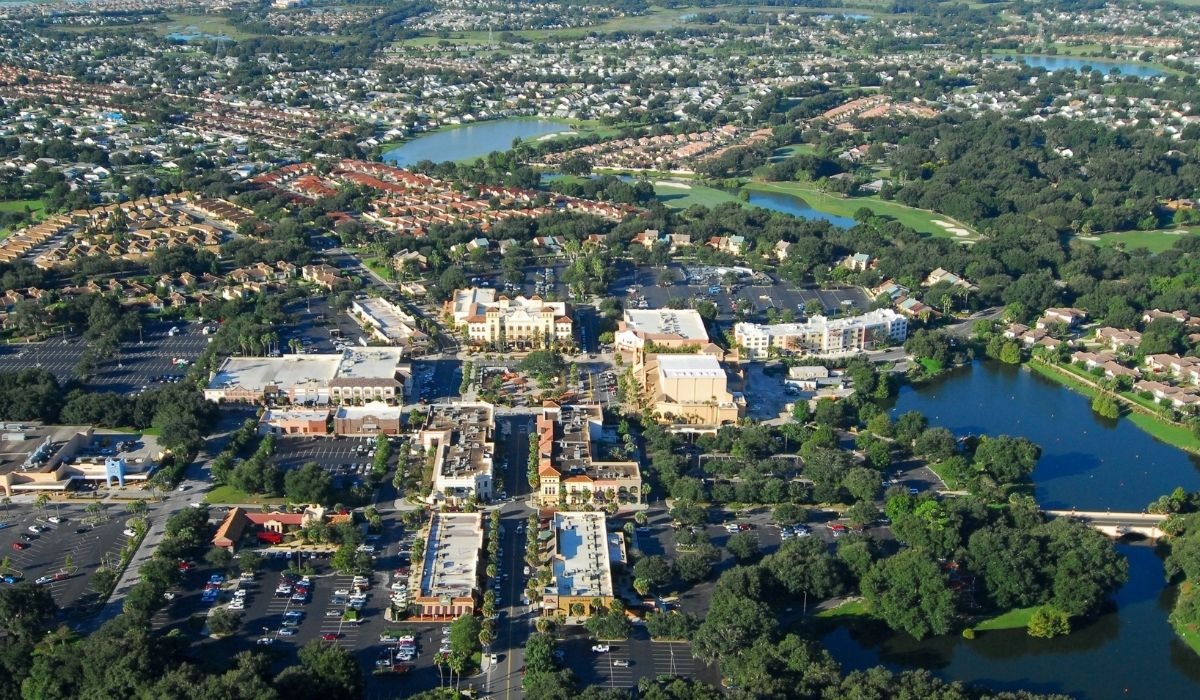
The Villages began in the 1970s as a modest mobile home park in Central Florida, spanning Sumter, Marion, and Lake counties. It has since grown into the largest age-restricted community on Earth, with more than 130,000 residents as of recent counts — a population that genuinely exceeds the island of Manhattan. According to U.S. Census data cited on Wikipedia, 84.7% of Villages residents are aged 65 or older, and the community spans nearly 34 square miles.
The numbers involved are genuinely staggering. The Villages includes more than 100 miles of golf-cart-friendly streets, over 100 golf courses, three full town squares with free nightly entertainment, more than 100 restaurants, over 3,000 resident-led social clubs, and — for the pickleball enthusiasts — 241 dedicated pickleball courts. It has its own dedicated fire department. It has expansion plans that could add another 60,000 homes over the next two decades.
What makes The Villages significant beyond its scale is what it proved to the broader real estate industry: that a genuinely enormous, sustained market existed for retirees who wanted an active, socially rich, amenity-dense lifestyle rather than a quiet bungalow and not much else. Every subsequent Florida 55+ development, whether built by a national homebuilder or a regional developer, is in some way responding to the demand The Villages demonstrated was real and durable.
Why Florida Specifically Became Ground Zero
Arizona invented the concept. New Jersey has its own significant cluster of age-restricted communities. So why did Florida become the undisputed national capital of 55+ living?
No state income tax. For retirees living on fixed incomes, pensions, and Social Security, Florida's lack of a state income tax translates into a genuinely meaningful difference in disposable retirement income compared to many Northern and Midwestern states.
Climate. Florida's warm, mild winters have been drawing seasonal and permanent retirees for generations — the same underlying demographic engine that shaped South Florida's broader cultural development, as we've covered in prior Florida Current reporting.
Land availability. Florida's interior — Central Florida especially — offered developers enormous tracts of relatively inexpensive, buildable land, ideal for the sprawling, amenity-rich master-planned communities that define the modern 55+ model. This is precisely the kind of land that made The Villages' scale possible in a way that would be far more difficult in a denser, more built-out state.
A self-reinforcing cycle. Once Florida established a critical mass of 55+ communities, an entire supporting ecosystem grew around them — specialized healthcare providers, golf course maintenance industries, retiree-focused retail, and a robust real estate marketing infrastructure specifically built around age-restricted living. Each new community made the next one easier and more profitable to build.
The Reddit consensus among longtime Florida residents is blunt but accurate: "Retiring to Florida" has been the engine behind a meaningful share of the state's overall population growth for the better part of a century. The 55+ community industry didn't create that migration pattern — it organized and monetized a demographic wave that was already happening.

What Life in a 55+ Community Actually Looks Like
Beyond the legal framework and demographic history, it's worth understanding what actually distinguishes daily life in these communities.
Amenity-centered design. Clubhouses, pools, fitness centers, golf courses, and organized social clubs are the defining physical feature. Many communities operate more like resort campuses than traditional neighborhoods.
Minimal home maintenance. Many 55+ communities — particularly attached and villa-style developments — bundle exterior maintenance, landscaping, and sometimes roof replacement into HOA fees, appealing directly to residents who want ownership without the physical upkeep burden.
Built-in social infrastructure. Unlike a standard neighborhood where residents build community organically (or don't), 55+ communities are deliberately engineered around clubs, classes, and organized activities — reducing the isolation risk that researchers consistently identify as a genuine health concern for older adults living alone.
Costs that vary widely. According to Rocket Mortgage's analysis of 55+ community costs, monthly expenses (including HOA fees) can range broadly from $1,500 to $4,000 or more, depending heavily on the level of luxury, golf access, and amenities involved. Age-restricted community HOA fees specifically tend to run $100 to $500 monthly on top of that, according to Wikipedia's overview of the category.
No on-site medical care, generally. It's worth being clear-eyed about this: standard 55+ communities are not assisted living or memory care facilities. They are independent living for active older adults — a meaningfully different category from the specialized senior care we've covered previously.


The Legal Fine Print Buyers Should Understand
For anyone actually considering a purchase, a few practical points deserve attention before signing anything:
Ownership and residency are legally separate. Anyone — of any age — can technically own property in a 55+ community. The age restriction governs who can live there, not who can hold the title. This matters for adult children who might inherit or co-sign on a parent's home.
Grandchildren can visit, but generally can't live there permanently. HOPA's exemption is specifically about permanent residency, not short-term family visits — a distinction that occasionally causes friction but is generally well understood by community management.
Rental restrictions vary significantly by community. Some Florida 55+ communities prohibit renting to anyone under 55 entirely; others have more flexible arrangements. This is genuinely worth confirming in writing before either buying as an investment property or planning to rent out a unit later.
Compliance isn't automatic or permanent. As noted above, communities must actively maintain their HOPA-qualifying status through documented policies and regular age verification. A community that lets this lapse can lose its legal ability to enforce the age restriction — a scenario that has resulted in real disputes and litigation in Florida HOA law.


Florida's 55+ Communities FAQ
Why are 55+ communities legal if they exclude families with children? The Housing for Older Persons Act (HOPA), passed in 1995, created a specific federal exemption allowing communities to legally restrict residency by age, provided they meet three conditions: at least 80% of units occupied by someone 55 or older, documented policies demonstrating intent to serve older residents, and compliance with HUD's age verification procedures. Without HOPA, this kind of age restriction would likely conflict with federal fair housing protections.
What is the 80/20 rule for 55+ communities? Under HOPA, at least 80% of occupied units in a qualifying community must have at least one resident aged 55 or older. The remaining 20% can be occupied by younger residents — commonly a caregiver, a younger spouse, or in some cases a legally permitted exception — without jeopardizing the community's overall age-restricted status.
Is The Villages really the largest retirement community in the world? Yes. The Villages, spanning Sumter, Marion, and Lake counties in Central Florida, has more than 130,000 residents as of recent counts — a population larger than the island of Manhattan — making it the largest age-restricted community on Earth. It began as a modest mobile home park in the 1970s before growing into its current scale.
Can grandchildren visit someone living in a 55+ community? Yes. HOPA's age restrictions govern permanent residency, not short-term family visits. Grandchildren and other family members can typically visit for reasonable periods; they generally cannot establish permanent residency in the home.
Can someone under 55 buy a home in a Florida 55+ community? Yes — ownership and residency are legally separate under HOPA. Anyone can hold title to a property in an age-restricted community, but the age restriction governs who is permitted to actually live there as a resident, subject to the community's specific occupancy policies.
Why did Florida specifically become the center of the 55+ community industry, rather than another state? A combination of factors: no state income tax (a meaningful advantage for fixed-income retirees), a warm year-round climate, abundant available land in Central Florida ideal for large master-planned developments, and a self-reinforcing industry ecosystem that grew up around the concentration of retirees already settling in the state.
Sources
55places.com — The History of 55+ Communities: How Active Adult Living Evolved
Florida Commission on Human Relations — Housing – 55 & Older Communities: fchr.myflorida.com
Becker Lawyers — "What Do You Mean We Cannot Enforce the Association's 55 and Older Provision?"
Wikipedia — The Villages, Florida; Age-restricted community
Wharton Real Estate Center, University of Pennsylvania — Legal Do's and Don'ts for Age-Restricted Communities
Rocket Mortgage — 55 and Over Communities: Pros and Cons
Florida Statutes § 760.29 — Online Sunshine
55places.com — The Villages® Community Profile
Recommended Reading
Information current as of July 2026.
Florida Current covers lifestyle, weather, outdoor life, and everything that comes with living in the Sunshine State. Browse our Florida Living section for regional guides, seasonal activity calendars, retirement guides and practical advice from people who actually live here.
Florida native Luana B. Gann brings more than 30 years of publishing, editing, and journalism experience to Florida Current. With a deep appreciation for the Sunshine State's culture, lifestyle, and ever-changing landscape, she is dedicated to helping readers discover what's new, noteworthy, and uniquely Florida.


CONTACT
Reach out for questions or feedback anytime.
contact@FLAcurrent.com
© 2026. All rights reserved.