Cuban Food in Florida: Tampa vs. Miami — Where to Find the Real Thing
Luana B. Gann, Editor
6/19/2026
One State, Two Cuban Kitchens: Where to Find the Real Thing in Tampa and Miami
Quick Answer Florida has two distinct Cuban food capitals, and both will argue passionately that the other one is doing it wrong. Tampa's Ybor City is the older tradition — Cuban cigar workers were building restaurant culture there in the late 1800s, a full generation before Miami became a Cuban exile destination. Miami's Little Havana carries the living, breathing heartbeat of post-revolutionary Cuban culture and a dining scene that is broader, deeper, and louder. Both are absolutely worth your time and your appetite. And yes, Tampa puts salami on the Cuban sandwich. Yes, that matters. We'll get to it.
Table of Contents
Two Cities, One Heritage, Zero Consensus
Florida's relationship with Cuban food is not a single story. It is at least two, running parallel for over a century, shaped by different waves of immigration, different historical moments, and two cities that are about as unlike each other as any two places in the same state can be.
Tampa's Cuban community arrived first — and came to work. In the late 1880s, cigar manufacturer Vicente Martinez-Ybor relocated his factory from Key West to a patch of land just east of Tampa and built an entire neighborhood around it: Ybor City. Cuban, Spanish, and Italian immigrant workers poured in. They built social clubs, bakeries, bodegas, and restaurants. They brought their food with them, adapted it to what was available, and created a culinary tradition rooted in working-class life and community identity. Tampa's Cuban food is old, grounded, and deeply tied to a specific place.
Miami's Cuban community arrived decades later — and came fleeing. After the Cuban Revolution of 1959, waves of Cuban exiles settled in Miami, transforming the city's southwest neighborhoods into what became Little Havana. The community grew rapidly, brought sophisticated urban food culture from Havana, and created a dining scene that is as much a living cultural expression as a place to eat. Miami's Cuban food is bigger, more varied, and carries a different kind of weight — the weight of a homeland that many in the community have never been able to return to.
Florida's deep cultural layering is something we've explored in our look at South Florida's culture — and nowhere does that layering show up more deliciously than at the table.
Neither city's Cuban food tradition is more "authentic" than the other. They are authentic to different things. That's the whole story.
Tampa: Where Cuban Food in Florida Began
Walk into Ybor City today and the bones of something genuinely old are still visible. The brick streets, the wrought-iron balconies, the social club buildings — they're still there, and so are some of the food institutions that fed the cigar rollers who built the neighborhood in the first place.
Tampa's Cuban food tradition is, at its core, working people's food. Hearty, filling, affordable, built for a long shift at a cigar factory. Ropa vieja — shredded beef slow-cooked in sofrito and tomatoes. Picadillo — seasoned ground beef with olives and raisins, served over white rice. Lechon asado — slow-roasted pork that defines the Cuban sandwich. Black beans and rice so well-seasoned you barely need anything else on the plate. Cuban bread from a bakery that has been making it the same way since 1915, shaped and baked by hand, laid on palmetto fronds to develop its distinctive crust.
What Tampa added to the Cuban food tradition that no one else did — and this is the detail that sends Miami into spirited disagreement — is Genoa salami on the Cuban sandwich. Italian immigrants worked alongside Cuban immigrants in Ybor City's cigar factories. Their culinary influence ended up in the sandwich. Tampa's cubano has roast pork, ham, Swiss cheese, pickles, mustard, Cuban bread — and salami. That's the Tampa version. That's the original, as far as Tampa is concerned. And Tampa has been making it since the late 1800s, so they have a reasonable case.
Florida Current Note Ybor City was designated a National Historic Landmark District in 1990. The neighborhood's food culture is inseparable from its history as one of the most significant immigrant communities in Florida. Much like the Greek community in Tarpon Springs, Ybor City is a place where immigrant identity was preserved through food, faith, and stubbornness — in the best possible sense.


Where to Eat in Tampa: The Spots Worth Finding
Columbia Restaurant — Ybor City
If there is one restaurant in all of Florida that is genuinely irreplaceable, the Columbia in Ybor City is on the very short list. Opened in 1905 — making it Florida's oldest restaurant — the Columbia has been owned and operated by the same family for six generations. It is the world's largest Spanish restaurant, occupying an entire city block and seating more than 1,700 guests across multiple dining rooms. The flamenco show runs nightly. The "1905" salad is prepared tableside. The Ropa Vieja and the Cuban sandwich are the standards against which everything else in Tampa is measured.
This is not a museum. It is a working, thriving restaurant that fills up on weeknights. Reservations are strongly recommended. Visit columbiarestaurant.com for hours and bookings.
La Segunda Central Bakery — Ybor City and Tampa Bay
La Segunda is not a restaurant. It is the source. Founded by Juan Moré in 1915, La Segunda has been baking Cuban bread the same way for 110 years — by hand, on a hearth, laid on palmetto fronds that give the loaf its signature thin, crackling crust. The bakery now produces approximately 20,000 loaves daily and supplies restaurants across the region. Four generations of the Moré family have kept the recipe and the method unchanged.
You can get a full Cuban sandwich at La Segunda, and you should. But even if you just walk in and buy a loaf of bread to take back to wherever you're staying, you'll understand immediately why Tampa's Cuban sandwich starts with this bread and nothing else. Visit lasegundabakery.com — they also ship nationally through Goldbelly.
West Tampa Sandwich Shop — West Tampa
West Tampa, the neighborhood just west of downtown, has its own deep Cuban food history that predates Ybor City's tourism development. The West Tampa Sandwich Shop is the kind of no-frills, old-school lunch spot that has been quietly doing it right for decades while other places came and went. The Cuban sandwich here is the real Tampa version — salami included, pressed on bread from La Segunda, priced like it still costs what lunch should cost.
Brocato's Sandwich Shop — Ybor City
Another Ybor City institution with deep roots, Brocato's has been serving Tampa-style Cuban sandwiches to locals who know better than to drive past it. The Italian surname is not a coincidence — it reflects the same immigrant-community overlap that put salami in the sandwich to begin with. Straightforward, consistent, and exactly what you want.
La Setima Club — Ybor City
Named for Seventh Avenue — "La Setima" in the old neighborhood parlance — this spot brings together the cocktail culture and Cuban food in a setting that feels true to Ybor City's social club history. The food is good, the atmosphere earns its reputation, and the 4.8 rating on Yelp suggests it is not keeping any secrets.
Florida Current Tip Ybor City's International Cuban Sandwich Festival happens annually, typically in the spring. It is exactly what it sounds like, and it is exactly as good as you hope. Check ybor.org for dates and details.
Miami: The Cuban Kitchen That Never Stopped Growing
Miami's Little Havana is a different animal entirely from Ybor City, and understanding why makes the food more interesting.
When Cuban exiles began arriving in Miami after 1959, they didn't just bring recipes. They brought an entire urban food culture — the cafeterias, the bakeries, the ventanitas (walk-up windows where you order a cafecito and stand on the sidewalk), the social clubs, the Sunday lunches that lasted four hours. They recreated, as faithfully as possible, the food culture of a Havana they expected to return to. Decades passed. Many never did. The food became something of its own — Cuban, but Miami Cuban. Rooted in memory as much as in recipe.
Little Havana today is centered on Calle Ocho — Southwest 8th Street — and stretches through a dense, loud, colorful neighborhood where Spanish is the default language, cafecito costs less than a dollar at the right ventanita, and the smell of roasting pork on a weekend morning is as reliable as sunrise. The dining scene has also evolved beyond the traditional Cuban restaurants into something more contemporary — chef-driven spots that honor the tradition while doing something new with it.
Miami's Cuban sandwich, for the record: roast pork, ham, Swiss cheese, pickles, mustard, pressed on Cuban bread. No salami. Miami did not have Italian cigar workers. Miami's community came from Havana. The sandwich reflects that.

Where to Eat in Miami: Little Havana's Best Tables
Versailles Restaurant — Little Havana
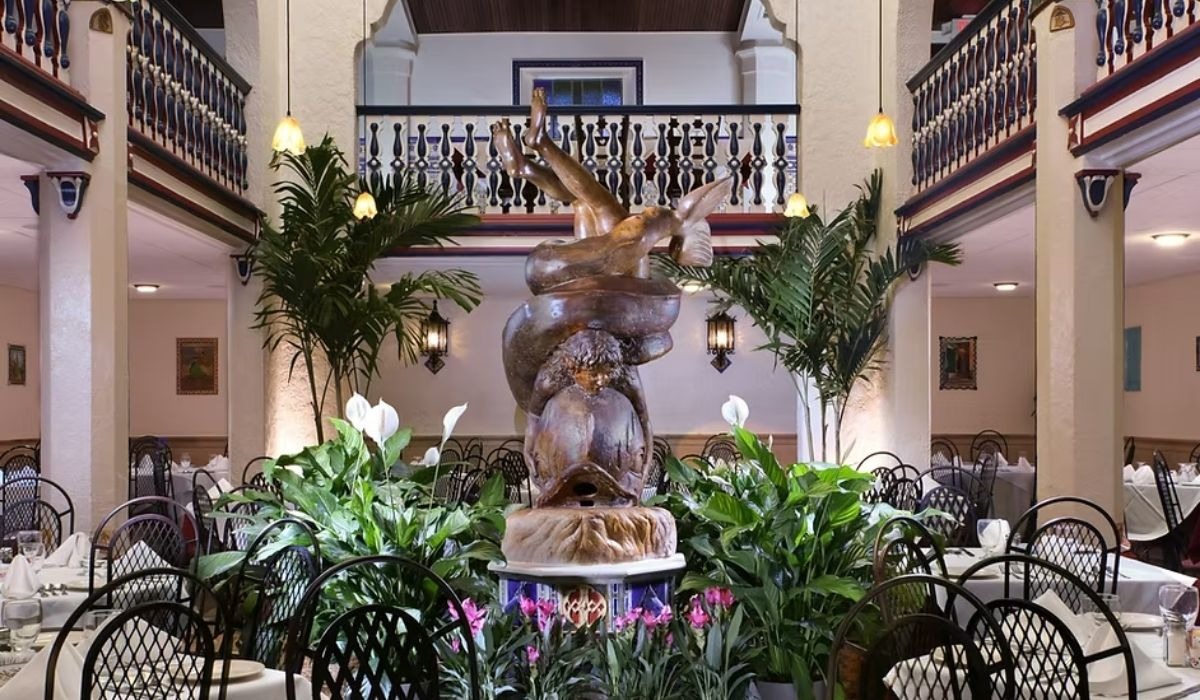
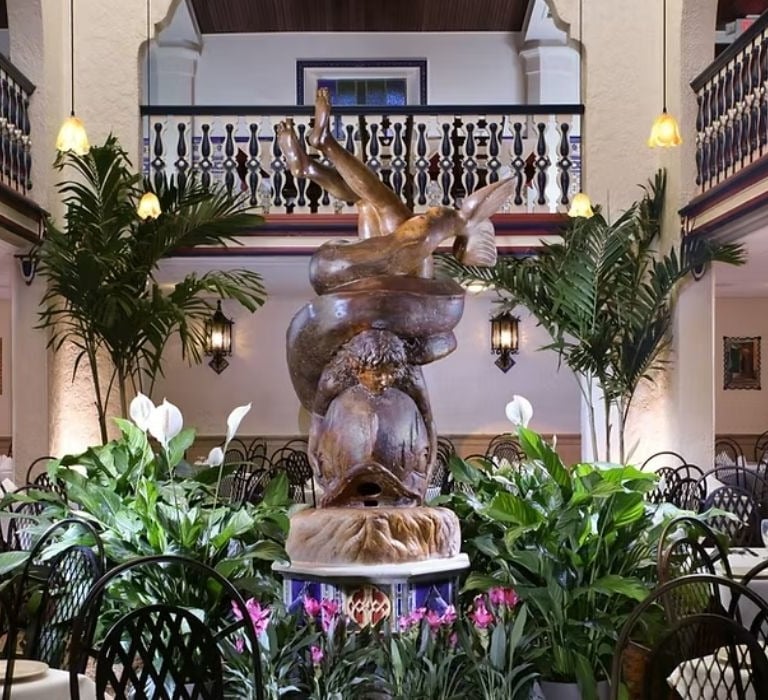
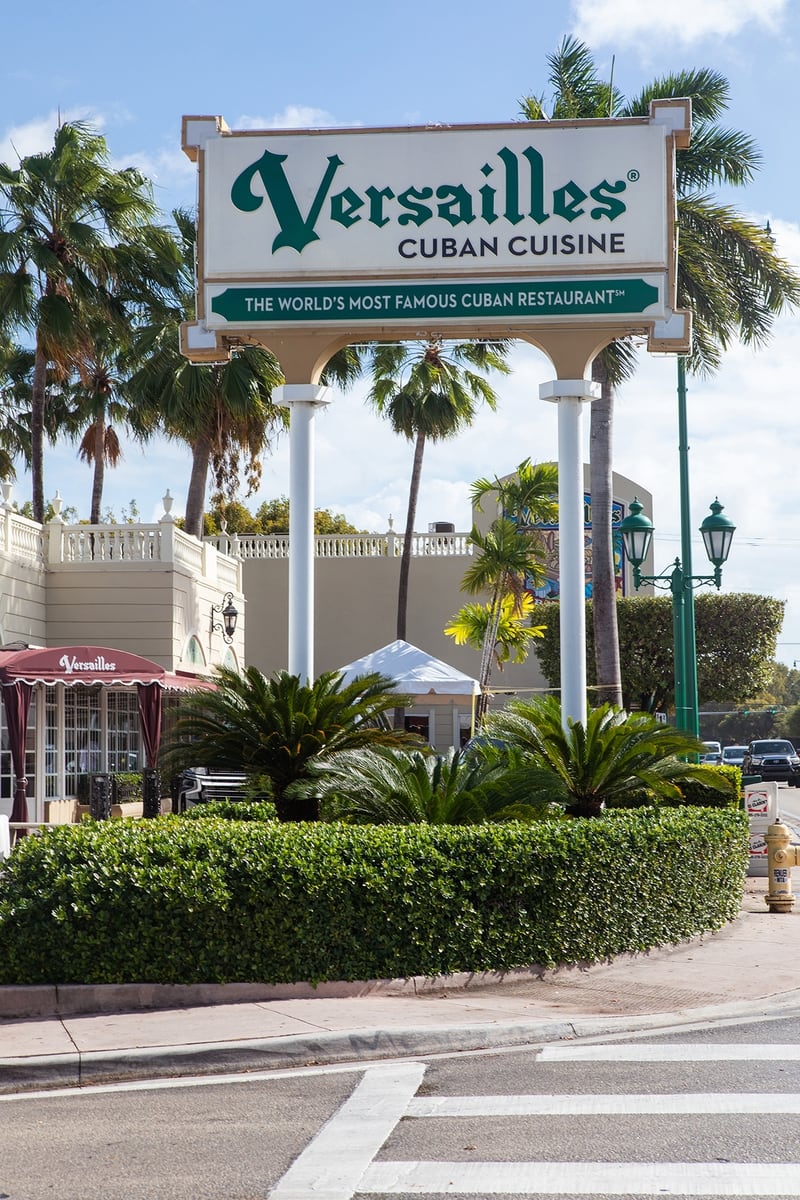
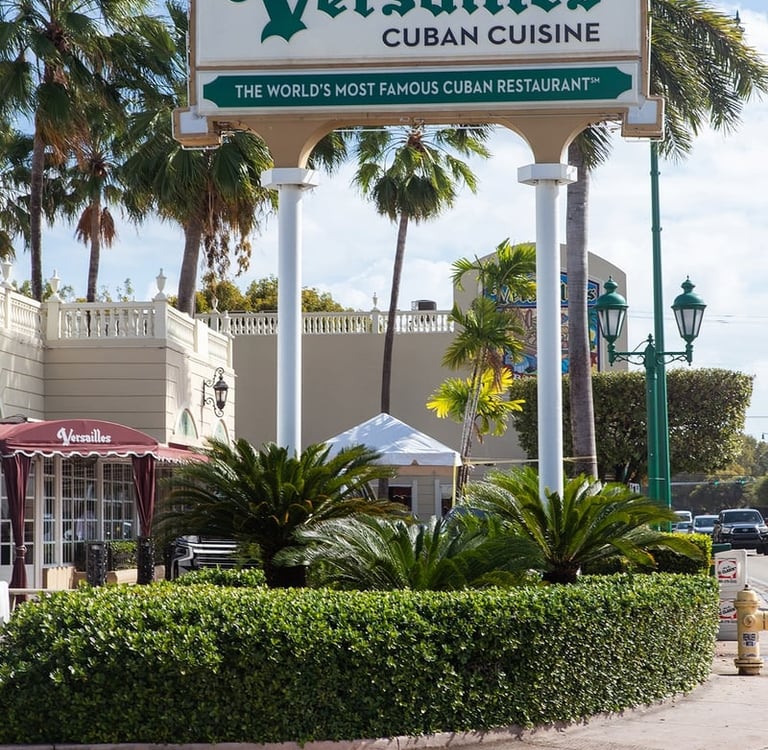
Versailles calls itself "The World's Most Famous Cuban Restaurant," and the claim is not unreasonable. Opened in 1971 by Cuban exile Felipe Valls on Calle Ocho, Versailles has been the gathering place for Miami's Cuban community for over five decades — for celebrations, for political arguments, for mourning, for Tuesday lunches, for every significant moment in the life of a community that has experienced a great deal of significance. Presidents have eaten here. Protests have organized outside it. The cafecito counter is an institution within an institution.
The food is traditional Cuban, generously portioned, and reasonably priced. The Cuban sandwich is the standard. The ropa vieja is reliable. The pastelitos from the adjacent bakery are worth a separate stop. Visit versaillesrestaurant.com — they're open daily with extended hours.
Old's Havana Cuban Bar & Cocina — Little Havana
Old's Havana, also on Calle Ocho, brings the visual energy of pre-revolutionary Havana to every surface of the space — vintage photography, warm lighting, live music, a color palette that feels like an old postcard. The food holds up to the atmosphere: Cuban sandwiches, yucca fries, ropa vieja, picadillo, lechon, and a cocktail program that takes the mojito seriously. With a 4.8 rating across more than 23,000 reviews, this is not a tourist trap that coasts on aesthetics. Visit oldshavana.com.
Cafe La Trova — Little Havana
Cafe La Trova is where Cuban food tradition and serious culinary ambition meet on very good terms. Founded by Julio Cabrera — a celebrated maestro cantinero, or master bartender, in the Cuban tradition — and James Beard Award-winning chef Michelle Bernstein, La Trova has been named one of the World's 50 Best Bars in 2023, 2024, and 2025, and was the #1 Best Bar in the South in 2022. The cocktail program is exceptional; the food is chef-driven Cuban that respects the tradition while doing something creative with it. This is where you go when you want the full Little Havana experience at a slightly elevated level. Visit cafelatrova.com.
El Rey De Las Fritas — Little Havana
The frita is a Cuban-style burger — seasoned ground beef on a small, soft roll with shoestring potato fries piled on top — and El Rey De Las Fritas is considered by many to be the best place in Miami to eat one. It is a counter-service spot with minimal ambiance and maximum commitment to doing one thing at a very high level. If you have never had a frita, this is the place to try it.
Sanguich Little Havana — Little Havana
Sanguich is the Cuban sandwich done with focus and precision. The name is the phonetic spelling of "sandwich" in Cuban Spanish slang, and the restaurant is entirely devoted to getting that sandwich exactly right — the bread, the pork, the pressing, the proportion. The Infatuation named it one of the best restaurants in Little Havana. For visitors who want to understand Miami's Cuban sandwich on its own terms — without salami, pressed perfectly, on proper bread — this is the place.
The Cuban Sandwich Showdown: Tampa vs. Miami
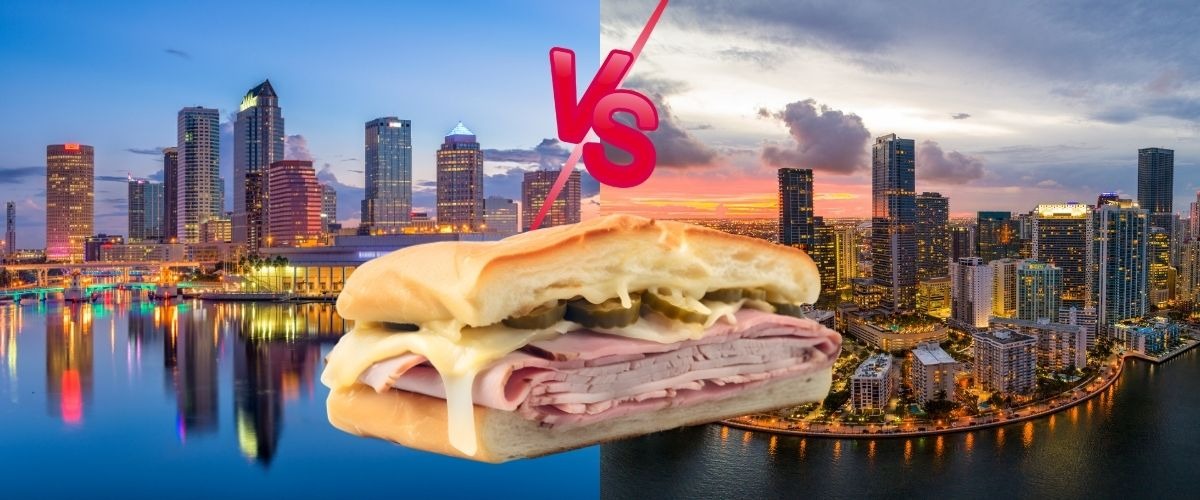
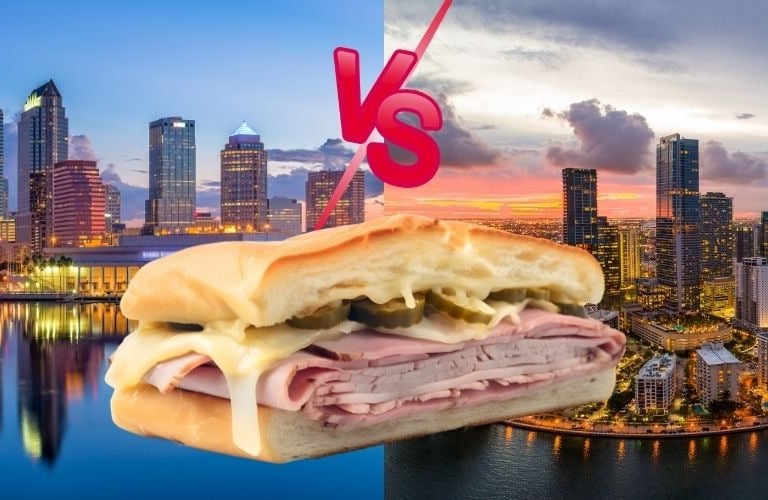
It would be irresponsible to write this article and not address the sandwich directly, so here it is:
Tampa Cuban sandwich: Roast pork, ham, Genoa salami, Swiss cheese, dill pickles, mustard, pressed on Cuban bread from La Segunda or equivalent.
Miami Cuban sandwich: Roast pork, ham, Swiss cheese, dill pickles, mustard, pressed on Cuban bread. No salami.
Both are pressed flat in a sandwich press until the bread is crispy and the cheese is melted through. Both are correct. They reflect the communities that made them.
Tampa's version is older by historical record. The Ybor City cigar community was making something close to the modern Cuban sandwich in the 1890s, and the salami reflects the Italian workers who shared the factory floor. Miami's version reflects the Havana exile community that arrived starting in 1959 — a sandwich mixto tradition from Cuban cafeteria culture that didn't include salami because there were no Italian cigar workers involved.

Florida Current Take We are not going to declare a winner. Both cities would take it personally, and both cities would be right to. What we will say is this: if you are in Florida and you have not eaten a proper Cuban sandwich in Tampa AND a proper Cuban sandwich in Miami, you have two very good reasons to plan two very good trips.
The Cuban Sandwich Tampa vs Miami FAQ
What is the difference between a Tampa and Miami Cuban sandwich? Salami. Tampa's version includes Genoa salami along with roast pork, ham, Swiss cheese, dill pickles, and mustard on pressed Cuban bread. Miami's version has the same lineup minus the salami. The Tampa version reflects Italian immigrant workers who shared Ybor City's cigar factory floors with Cuban workers in the late 1800s. Miami's version follows the sandwich mixto tradition of Havana exile culture that arrived after 1959. Both are pressed. Both are correct. The debate is eternal.
What is the best Cuban restaurant in Tampa? The Columbia Restaurant in Ybor City — open since 1905, Florida's oldest restaurant, six generations of the same family — is the landmark. For the Cuban sandwich itself, La Segunda Central Bakery, baking Cuban bread since 1915, is essential. West Tampa Sandwich Shop and Brocato's are the local favorites for traditional Tampa-style cubanos without the tourist markup.
What is the best Cuban restaurant in Miami? Versailles on Calle Ocho — open since 1971, more than five decades at the center of Miami's Cuban cultural and political life. Old's Havana for atmosphere and consistently excellent food. Cafe La Trova for chef-driven Cuban cuisine and an exceptional cocktail program, ranked in the World's 50 Best Bars three years running. El Rey De Las Fritas for the Cuban frita burger. Sanguich for the sandwich done precisely right.
Where did the Cuban sandwich originate — Tampa or Miami? Tampa has the older record. Cuban cigar workers in Ybor City were eating early versions of the sandwich in the late 1800s, and La Segunda Bakery has been baking the bread since 1915. Miami's Cuban sandwich tradition developed after 1959. Both cities make their case loudly. Tampa's predates Miami's by several decades. Miami's version is what most of the world calls a Cuban sandwich. Florida contains multitudes.
What should I order at a Cuban restaurant in Florida? Start with the Cuban sandwich — Tampa style with salami, Miami style without, depending on which city you're in. Beyond that: ropa vieja, picadillo, lechon asado, black beans and rice, yuca con mojo, and pastelitos. To drink: cafecito or café con leche. At Cafe La Trova in Miami, the mojito is mandatory.
Is Little Havana in Miami worth visiting? Yes. Little Havana along Calle Ocho is one of the most culturally specific and genuinely alive neighborhoods in Florida. The food is real, the coffee is strong, and Domino Park — where men play dominoes on the sidewalk every day as they have for decades — is one of those Florida scenes you don't forget. Go hungry, go on a weekend, and go with time to walk around.
Is Ybor City in Tampa worth visiting for Cuban food? Absolutely. Ybor City is a National Historic Landmark with 19th-century bones and a Cuban food tradition older than Miami's. The Columbia Restaurant alone is worth the trip. Add a sandwich from La Segunda, a walk through the brick streets, and a stop at one of Ybor's old social club buildings, and you have a Florida day that most visitors completely miss.
Sources
Columbia Restaurant — columbiarestaurant.com
La Segunda Central Bakery — lasegundabakery.com and "The Story of the Cuban Sandwich" — lasegundabakery.com/blog
Versailles Restaurant — versaillesrestaurant.com
Cafe La Trova — cafelatrova.com
Old's Havana Cuban Bar & Cocina — oldshavana.com
The Infatuation Miami — "The 19 Best Restaurants in Little Havana" — theinfatuation.com
GoNomad Travel — "Cuban Sandwich: Tampa or Miami" — gonomad.com
Cigar City Magazine — "Cuban Bread Tampa Style" — cigarcitymagazine.com
Visit Ybor — ybor.org
Recommended Reading
South Florida Culture: Loud, Layered, and Like Nowhere Else on Earth
Tarpon Springs: Florida's Sponge Capital and the Greek Town That Time Forgot to Change
Information current as of June 2026. Restaurant hours, menus, and ownership can change — always verify directly with the restaurant before visiting.
Florida Current covers weather, lifestyle, outdoor life, and everything that comes with living in the Sunshine State. Browse our Florida Living section for regional guides, seasonal activity calendars, retirement guides and practical advice from people who actually live here.
Florida native Luana B. Gann brings more than 30 years of publishing, editing, and journalism experience to Florida Current. With a deep appreciation for the Sunshine State's culture, lifestyle, and ever-changing landscape, she is dedicated to helping readers discover what's new, noteworthy, and uniquely Florida.

Both winners!
CONTACT
Reach out for questions or feedback anytime.
contact@FLAcurrent.com
© 2026. All rights reserved.