Florida Beaches: Gulf vs. Atlantic and How to Pick the Right One
Luana B. Gann, Editor
6/8/2026
Quick Answer — Gulf vs. Atlantic Beaches in Florida The Gulf Coast offers warmer, calmer, typically clearer water with powdery white sand — ideal for families, swimming, and sunset watching. The Atlantic Coast has cooler water, more wave action, better surf, and some of Florida's most iconic beach towns. Neither coast is better. They're genuinely different experiences, and the right one depends entirely on what you want out of a beach day. Florida has over 1,300 miles of coastline. The only wrong choice is not going.
Here's a thing that happens to people visiting Florida for the first time: they book "a beach," they go to "the beach," and they come home either completely in love or mildly baffled — and in both cases they're not entirely sure why.
The reason is almost always this: they didn't realize that Florida has two very different coastlines, and that choosing between them isn't just geography. It's a personality test.
Table of Contents
Two Coasts, One State: What You're Actually Choosing Between
The Atlantic Coast: Waves, Energy, and a Different Kind of Beautiful
What the Brochures Don't Mention: Real Talk on Beach Safety and Seasonal Surprises
The Gulf Coast and the Atlantic Coast of Florida are separated by a thin peninsula and about 100 miles of interior at the widest point, but in beach terms they might as well be two different planets. Different water temperature. Different sand. Different waves. Different vibe. Different wildlife. Different crowds. Different parking situations (we said what we said).
We're going to break it all down — honestly, specifically, and with genuine affection for both sides — so that the next time someone asks you which Florida beach to visit, you can give them a real answer instead of a shoulder shrug.
Two Coasts, One State: What You're Actually Choosing Between
Florida is a peninsula — land on three sides of water, ocean on two of them, and a third coast's worth of beaches in the Keys that deserves its own category entirely (and will get it in a future article). The Gulf of Mexico lines the west side. The Atlantic Ocean runs the east. They share a state but almost nothing else.
Here's the side-by-side that tells the story:

That table alone should tell you a great deal. But let's go deeper.
The Gulf Coast: Calm, Warm, and Basically a Postcard
Why the Gulf Is What It Is
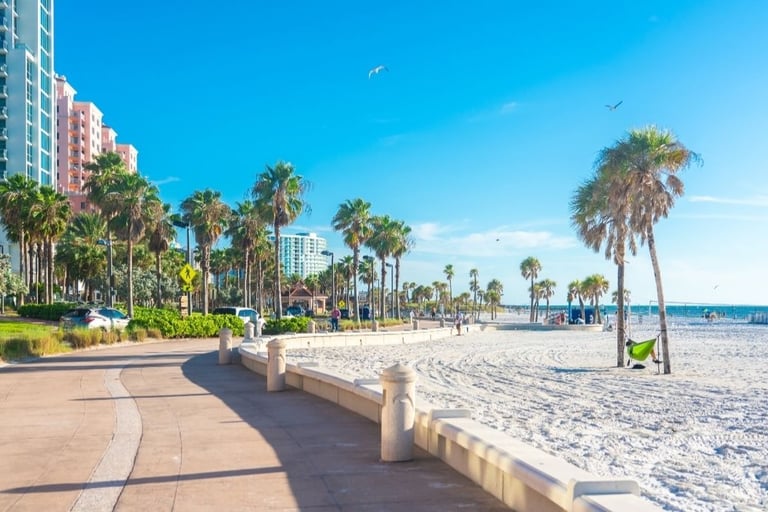
The Gulf of Mexico is not an ocean. It's a nearly enclosed body of water — surrounded by the United States, Mexico, and Cuba — which means it heats up faster, stays warmer longer, and doesn't generate the open-water wave action of the Atlantic. The result is beach conditions that, on a good day, look like they were invented by someone whose job was to design the perfect beach.
The water: In the summer months, Gulf water temperatures along Florida's coast regularly reach 85–90°F in the shallows, which is less "swim" and more "warm bath you didn't need to heat." Even in January, South Florida Gulf waters hover around 68–72°F — cold by Florida standards, absolutely balmy by everyone else's. The Panhandle Gulf is cooler in winter (50s and 60s), so if you're visiting the Emerald Coast in December, a wetsuit for swimming is not an embarrassing idea.
The sand: The Panhandle and Southwest Gulf Coast beaches have some of the finest, whitest sand on the planet — and that is not marketing copy. The sand is composed of quartz crystals ground down over millions of years as rivers carried it from the Appalachian Mountains to the coast. On the hottest summer day, you can walk across it in bare feet without suffering. Siesta Key's sand — 99% pure quartz — was awarded "World's Finest, Whitest Sand" by the Great International White Sand Beach Challenge in 1987. The award was real. The sand is still there. It still wins.
The waves: Gentle. The Gulf's enclosed nature means there's no significant ocean swell building over thousands of miles of open water. Small, rolling waves are the norm — which makes Gulf beaches ideal for young children, strong swimmers and weak swimmers alike, and anyone whose idea of a beach day involves floating peacefully on an inflatable something rather than getting knocked over by the sea.
The colors: Particularly in the Panhandle, the water runs a shade of turquoise and emerald green so vivid that first-time visitors routinely assume a filter was applied to every photograph they've ever seen. None was. That's the real color of the water above bright white quartz sand in the Destin and 30A area. It's legitimately extraordinary.
The Gulf's Crown Jewels: The Panhandle
Florida's Panhandle — the stretch along the north Gulf from Pensacola to Panama City Beach — is home to what many consider the finest beach conditions in the continental United States. The locals call it the Emerald Coast, and when you see it, you'll understand immediately.
Destin sits at the heart of it: a former fishing village turned popular resort town, with sugar-white sand, clear emerald water, and the kind of seafood reputation that takes decades to build legitimately. The water here is clear enough to see your feet in the shallows and sometimes the bottom at 15 feet.
30A (State Road 30A, officially) runs through South Walton County between Destin and Panama City Beach, threading through a string of boutique beach towns — Seaside (yes, that Seaside, where The Truman Show was filmed, and which has been charming visitors with its pastel architecture and planned community design since the 1980s), Rosemary Beach, Grayton Beach, Watercolor, and a dozen others, each one a little different, none of them a chain-restaurant-and-souvenir-shop situation. It also passes by 15 rare coastal dune lakes — a geographical phenomenon found in very few places on Earth, where freshwater lakes sit separated from the Gulf by dunes, periodically breaching to mix with saltwater. They're stunning and genuinely unusual.
Panama City Beach offers the same beautiful water but leans more commercial — big resorts, more nightlife, spring break energy if that's your season. There's nothing wrong with it; it's just a different flavor than 30A.
Pensacola Beach anchors the western end with some of the most photogenic Gulf water in the state, backed by Gulf Islands National Seashore — miles of undeveloped barrier island that is genuinely, peacefully, magnificently empty.
The Gulf's Southwest Gems
Drop down the peninsula and the character shifts slightly. The water stays warm and beautiful, but the landscape softens from dune-lined Panhandle to a more tropical Southwest Florida feel.
Clearwater Beach (Pinellas County) consistently wins national beach rankings — Dr. Beach, TripAdvisor, you name it — for its clean, wide beach, excellent facilities, family-friendliness, and consistent water conditions. It earns those awards honestly.
Caladesi Island State Park (accessible by ferry from Honeymoon Island near Dunedin) is what happens when the crowds don't follow: a pristine, undeveloped barrier island with zero hotels, zero condos, no cars, and some of the most beautiful Gulf beach in the state. The ferry keeps it accessible without overwhelming it.
Anna Maria Island, just south of Tampa Bay, has made a conscious decision to stay small. No high-rise hotels. A free island trolley instead of traffic jams. Old Florida fishing village energy with a beach that is genuinely lovely. It's not a secret, but it feels like one.
Siesta Key (Sarasota) is where the scientists and the travel writers converge in rare agreement: the beach is extraordinary. The quartz sand is so fine and white it squeaks softly when you walk through it. The water is clear. The beach is wide. It has been ranked among the top beaches in the United States by multiple independent sources, repeatedly, not because Sarasota has a great PR department but because Siesta Key is genuinely that good.
Sanibel and Captiva Islands exist in their own category. Yes, they have beautiful beaches. But people who go to Sanibel go primarily to shell. Sanibel's unique east-west orientation — perpendicular to most barrier islands, which run north-south — combined with a broad, shallow underwater shelf acts like a funnel that collects shells from throughout the Gulf and deposits them in extraordinary quantities on Sanibel's beaches. Over 400 species have been documented. Travel & Leisure ranked it the #1 shelling destination in North America. Devoted shellers adopt a characteristic hunched posture known affectionately as the "Sanibel Stoop." It's absolutely a real thing and you will do it.
Florida Current Note: The best shelling happens at low tide, especially after storms and during spring tides (around new and full moons). Go early — ideally at or just before sunrise. The serious shellers are already there.
The Atlantic Coast: Waves, Energy, and a Different Kind of Beautiful
Why the Atlantic Feels Different
The Atlantic Ocean is, well, the Atlantic Ocean. An open body of water stretching uninterrupted from Florida to Europe (with a few continents in the way), generating swells and currents that the Gulf simply cannot replicate. Florida's Atlantic coast feels more like an ocean beach than the Gulf does — which, depending on what you're after, is either exactly the point or exactly the problem.
The water: Cooler, typically by 5–8°F compared to Gulf temperatures at the same latitude — and noticeably so when you're standing in it. Not cold — particularly in South Florida, where Miami Beach water stays in the 80s through summer — but a meaningful difference if you're comparing directly. It runs a deeper blue to blue-green rather than the Gulf's turquoise, and the water clarity varies more by location.
The waves: Here they exist, meaningfully. Not the towering storm surf of the North Atlantic, but real waves with real energy, particularly in winter when nor'easters push swell down the coast. This makes the Atlantic Coast Florida's surf coast — and it has produced, among other things, Kelly Slater, the greatest competitive surfer in history, who grew up in Cocoa Beach. The man is from here. The waves are here. There's a connection.
The sand: Varies more by location than the Gulf. Some Atlantic beaches have beautiful white sand; others run more tan, with a slightly coarser texture from the different sand composition (more shell fragments, feldspar minerals mixed in with the quartz). Not bad — just different.
The sunrises: The Atlantic's gift that the Gulf doesn't have. If watching the sun come up over the ocean is on your list, the Atlantic is your coast. It's genuinely something — particularly from quieter beaches where the only sounds are waves and birds.
Atlantic Florida from Top to Bottom
Amelia Island (Nassau County, far northeast Florida) is where the Atlantic Coast starts quietly and beautifully. Wide, pristine beaches, significant dunes, sea oats swaying in the breeze, and the kind of spacious natural beach that doesn't need a lot of infrastructure because the beach itself is the attraction. Horseback riding on the beach is permitted in some areas. It's stunning.
Jacksonville Beach, Neptune Beach, and Ponte Vedra Beach make up a varied stretch of Atlantic Coast within reach of Florida's largest city — a mix of surf culture, residential beach towns, and the occasional tournament-level golf course running alongside the dunes. A very livable, local stretch of Atlantic Florida.
St. Augustine Beach sits near the nation's oldest city, and if you want to combine serious history with a genuinely nice Atlantic beach — and fresh shrimp from a real fishing operation — this is your itinerary.
Daytona Beach is one of Florida's most famous Atlantic beaches, known for its extraordinarily wide, hard-packed sand and the cars that have historically been driven on it (yes, on the beach — still permitted in designated areas). NASCAR legend runs deep here. The beach is wide, flat, and busy; it's not the most peaceful of Florida beach experiences, but it's a Florida institution.
New Smyrna Beach is where the surfing crowd, the art crowd, and the locals who want a real town rather than a resort development have found their place. Consistent waves, a walkable downtown, good restaurants, and a beach that feels like it belongs to the people who live there rather than a hotel corporation. It's one of Florida's great beach towns.
Cocoa Beach is Kelly Slater's hometown, home to the oldest surf shop in the United States (Ron Jon Surf Shop, which is emphatically worth seeing even if you've never touched a surfboard), and gateway to the Space Coast — meaning you can watch a rocket launch from the beach, which is an experience that tends to make people cry unexpectedly and never entirely regret it.
Sebastian Inlet State Park is where serious Florida surfers go. The inlet structure creates consistent, well-shaped waves that produce better surf than almost anywhere else on the Florida coast. It's also gorgeous — clear water, good snorkeling, fishing — but on the right swell day, the surf crowd makes clear what this stretch of coast is really for.
Juno Beach and Jupiter (Palm Beach County) quiet back down after the bustle of Cocoa Beach and Brevard County. Jupiter Beach is beautiful, relatively uncrowded for its quality, and sits in a county that takes coastal preservation seriously. Juno Beach is one of the most important loggerhead sea turtle nesting beaches in the world — the Loggerhead Marinelife Center there is a working sea turtle hospital and education center that is genuinely worth visiting.
Miami Beach / South Beach needs no introduction and gets one anyway: art deco architecture, the turquoise Atlantic, an ocean promenade, world-class people watching, and a beach scene that has been globally famous for decades for good reason. It's not quiet. It's not uncrowded. It is, however, undeniably spectacular, and anyone claiming otherwise has an agenda.
Fort Lauderdale Beach is Miami Beach with slightly less intensity — a wide, clean, well-maintained Atlantic beach with a proper pedestrian promenade, good restaurants, and water that is genuinely beautiful. It deserves more credit than it typically gets as a standalone beach destination.


Best of Both Coasts: Our Honest Picks
Because someone is going to ask, and fair enough. Here's how we'd rank them by category — both coasts, honestly:
Best Overall Gulf Beach
Siesta Key — The quartz sand is scientifically extraordinary and visually unforgettable. The water is warm and clear. The beach is wide. The parking is imperfect (welcome to Florida), but everything else earns its reputation.
Runner-up: Caladesi Island State Park — because untouched and accessible is a rare combination
Best Overall Atlantic Beach
Amelia Island — Natural, wide, historically rich, unhurried, genuinely beautiful. The Atlantic at its most quietly confident.
Runner-up: New Smyrna Beach — for the rare combination of real waves, real town, real food
Best for Families with Young Children
Gulf, full stop. Calm, warm, shallow water changes the experience for small children and anxious parents fundamentally. Clearwater Beach specifically has great facilities, lifeguards, and easy access. Fort De Soto Park in Pinellas County is a superb, more natural option.
Best for Surfing
Sebastian Inlet State Park — No contest for consistent quality. New Smyrna Beach and Cocoa Beach for volume and community.
Best for Shelling
Sanibel Island — Ranked the best in North America. Not hyperbole.
Best for Sunsets
Anywhere on the Gulf Coast. Pick your beach, face west, wait. Every Gulf sunset earns its reputation.
Best for Sunrises
Amelia Island or Vero Beach — Quiet Atlantic beaches at dawn are a specific kind of perfect.
Best for People-Watching and Energy
South Beach (Miami) — the obvious answer remains the correct answer.
Best Hidden Gulf Gem
Cape San Blas (Gulf County, Panhandle) — remote, uncrowded, dog-friendly, pristine. The Panhandle's best-kept non-secret.
Best Hidden Atlantic Gem
Bill Baggs Cape Florida State Park (Key Biscayne, Miami-Dade) — a state park beach right next to Miami that feels like it's on a different planet from South Beach. One of the most beautiful beaches in Florida, period.


How to Pick the Right Beach for What You Actually Want
Here's the honest decision matrix. No judgment on any answer:


What the Brochures Don't Mention: Real Talk on Safety and Seasonal Surprises
Florida beaches are extraordinary. They are also real places with real conditions, and knowing a few things before you go makes the experience better — and occasionally keeps you from a very bad afternoon.
Rip Currents: The Beach's Biggest Hazard
Rip currents are the leading weather-related cause of death at Florida beaches — and they look like nothing. A rip current is a narrow channel of water moving away from shore, often in an area of calm, flat water between breaking waves. Beachgoers mistake them for safe, gentle spots to swim. They are not.
If you're caught in a rip current: Stay calm. Do not fight it by swimming directly back to shore — you will exhaust yourself. Swim parallel to the shoreline until you're out of the current, then swim back at an angle. If you can't swim out, float on your back, face the shore, and wave for help.
The Florida Department of Health and NOAA both publish daily rip current forecasts. Check conditions before you go in, particularly on Atlantic beaches where wave energy is higher.
Know Your Beach Flags
Florida beaches use a standardized colored flag warning system. Know these before you hit the water:


Red Tide: The Gulf's Seasonal Challenge
Red tide — caused by a harmful algal bloom called Karenia brevis — is a real phenomenon on Florida's Gulf Coast, occurring most commonly from late summer into fall (August through November, most years). A significant red tide bloom can cause:
Fish kills and dead marine life washing onto beaches
Respiratory irritation on the beach from aerosolized toxins (coughing, eye irritation — particularly problematic for people with asthma)
Shellfish closures
Red tide is natural, not caused by pollution, and it varies enormously year to year — some seasons are minor, some significant. Check current red tide conditions at myfwc.com before heading to a Gulf beach in late summer or fall.
Florida Current Tip: On an active red tide day, even healthy people may notice throat tickle or eye irritation on the beach. If you have asthma or respiratory issues, check the map seriously before going. The Atlantic Coast is not affected.
Jellyfish and Man O' War
Jellyfish are part of the Florida beach experience. Most are harmless (cannonball jellyfish, moon jellyfish). The one to respect is the Portuguese Man O' War — technically not a jellyfish but a colony of organisms — which looks like a translucent blue-purple bubble with long trailing tentacles and delivers a genuinely painful sting. They're more common on the Atlantic Coast, blown in from open ocean by offshore winds.
If stung by a Man O' War: Remove tentacles carefully (not with bare hands), rinse with seawater (not fresh water, which worsens the sting), and apply heat if available. Seek medical attention for significant reactions.
Purple flags on the beach signal dangerous marine life. Take them seriously.
No-See-Ums: Tiny, Invisible, and Very Annoying
The no-see-um (biting midge, Culicoides furens) is a microscopic biting insect that the Florida Gulf Coast produces in impressive quantities. You cannot see them (hence the name). You absolutely feel them. They're worst at dawn and dusk, particularly on calm days with little breeze, especially in the warmer months.
Bug spray with DEET or picaridin helps. A solid sea breeze helps more — no-see-ums are weak fliers and can't penetrate much wind. On breezy Gulf beach days, they're rarely a problem. On still, humid afternoons or evenings, bring the spray.
Stingrays: The Shuffle That Saves You
Stingrays rest in the shallow sandbars where Gulf (and some Atlantic) beachgoers wade. They are not aggressive — they only sting when stepped on. The preventive measure is elegantly simple and universally called the stingray shuffle: shuffle your feet along the bottom rather than stepping. The stingray feels the vibration and moves. You don't step on it. No one has a bad day.
Teach it to every child. It works when applied consistently.
Florida Beaches FAQ
Q: Is the Gulf or Atlantic side of Florida better for beaches? Neither coast is objectively better — they offer genuinely different experiences. The Gulf has warmer, calmer water and whiter sand, ideal for families and swimming. The Atlantic has more wave energy, better surfing, stunning sunrises, and some of Florida's most iconic beach towns. Most Floridians have a strong personal preference and will argue for it vigorously.
Q: Which Florida beach has the whitest sand? Siesta Key Beach in Sarasota (Gulf Coast) is scientifically documented as having the finest, whitest sand in Florida — 99% pure quartz crystals. The Panhandle beaches from Pensacola through Destin and 30A also have exceptional white quartz sand. Atlantic beaches generally have tan to off-white sand with a slightly coarser texture.
Q: Is the water warmer on the Gulf side or Atlantic side of Florida? The Gulf Coast consistently runs 5–8°F warmer than the Atlantic Coast at the same latitude. Gulf water in peak summer regularly reaches 85–90°F in shallow areas. The Atlantic in South Florida (Miami area) is warm in summer but noticeably cooler than the Gulf throughout the year.
Q: What is the best Florida beach for families with small children? Gulf Coast beaches are generally better suited for young children because of the calmer, shallower water and gentler waves. Clearwater Beach (consistently ranked among the nation's best family beaches), Fort De Soto Park, and Siesta Key are excellent choices. Anna Maria Island offers a quieter, more residential beach feel with gentle Gulf water.
Q: What is the best Florida beach for surfing? Sebastian Inlet State Park (Atlantic Coast, Brevard/Indian River counties) is considered Florida's premier surf spot for consistent, well-shaped waves. New Smyrna Beach and Cocoa Beach (hometown of Kelly Slater) also have strong surf scenes and regular wave activity.
Q: When does red tide happen in Florida? Florida Gulf Coast red tide blooms most commonly occur from late summer through fall — roughly August through November — though it varies by year. Some years produce minimal blooms; others are significant. Check current conditions at myfwc.com before visiting Gulf Coast beaches in late summer or fall, particularly if you have respiratory sensitivities.
Q: Is it safe to swim at Florida beaches? Florida beaches are generally safe for swimming when flags indicate favorable conditions. The primary hazard at Florida beaches is rip currents — the leading cause of beach-related fatalities. Always check beach flag conditions, swim near lifeguarded areas when available, and know what to do if caught in a rip current (swim parallel to shore, not directly against the current).
Q: What beaches are near Orlando? Orlando sits roughly in the center of Florida, equidistant from both coasts — about 60 miles either way. Cocoa Beach (Atlantic) is the closest major beach, approximately 60 minutes east. For Gulf beaches, Clearwater Beach and the St. Pete/Clearwater area are about 90 minutes west. Both directions are very doable as day trips.
📚 More From Florida Current
Florida beaches are only the beginning. Here's where to go next:
Florida Weather Month by Month: What to Actually Expect — Knowing which months mean calm Gulf water and which months mean afternoon storms changes how you plan a beach day entirely
Wild Florida: What's Out There, What's Harmless, and What Deserves Your Respect — Sea turtles, stingrays, dolphins, and what to do when they show up on your beach day
Everyday Life in Florida: What It Actually Feels Like to Live Here — For the people who've been to the beach and are now seriously considering staying
Was this article helpful? Share it with someone who just said "I'm thinking about Florida" — the Gulf vs. Atlantic question is the first one they need answered.
Written by Florida native Luana B. Gann, who brings more than 30 years of publishing, editing, and journalism experience to Florida Current. With a deep appreciation for the Sunshine State's culture, lifestyle, and ever-changing landscape, she is dedicated to helping readers discover what's new, noteworthy, and uniquely Florida.
Sources: Florida Department of Environmental Protection, Florida Fish and Wildlife Conservation Commission (myfwc.com) Red Tide data, Florida Department of Health Rip Current Safety, NOAA National Weather Service, Visit Florida (visitflorida.com), Florida State Parks (floridastateparks.org), Sanibel-Captiva Tourism Association, U.S. Lifesaving Association, Great International White Sand Beach Challenge, Travel & Leisure beach rankings, Dr. Beach annual rankings. Information current as of June 2026.
CONTACT
Reach out for questions or feedback anytime.
contact@FLAcurrent.com
© 2026. All rights reserved.