Florida Weather Guide: Month-by-Month Temperatures, Seasons, and What to Expect
Luana B. Gann, Editor
6/5/2026


Everyone thinks they know Florida weather.
Sunshine. Palm trees. Beach days. Flip-flops. Eternal summer.
And all of those things are genuinely part of life here. But the full story is more layered, more regional, more surprising — and honestly more interesting — than the postcard version suggests.
On this page:
Florida's Most-Asked Weather Questions
Florida Weather by Region
Month-by-Month Florida Weather Guide
Understanding the Heat Index
The Biggest Weather Surprises for New Florida Residents
Florida Weather Myths vs. Reality
Florida can be warm enough for shorts in January and stormy enough to make you rethink your afternoon plans in August. In the Panhandle, you might wake up to frost in December. In Miami, you might never own a coat that actually gets used. In Central Florida, you can eat breakfast on a sunny patio, watch a towering thunderstorm roll through at 3 p.m., and be back outside by 5.
That's the real Florida weather story: not one climate, not one season, not one experience. It's a state that stretches over 500 miles from north to south, spans two coastlines, and contains weather patterns that would genuinely surprise someone who only knows Florida from a spring break memory or a retirement brochure.
If you're thinking about moving here, retiring here, snowbirding here, or just want to understand what the locals actually experience — here's the honest, detailed picture.
Quick Florida Weather Snapshot
For those scanning before the deep read:
Winters are mild to warm and widely considered the state's best season
Summers are hot, humid, and include near-daily afternoon thunderstorms
Florida is divided into two real meteorological seasons: wet and dry
Hurricane season runs June 1 through November 30
Florida averages about 230+ sunny days per year
The state's weather varies dramatically from north to south — where you live matters enormously
November through April is what most residents consider Florida's sweet spot
The UV index regularly hits "extreme" levels in summer — sunscreen here is not optional
Quick Answers: Florida's Most-Asked Weather Questions
These are the questions people ask most often — answered directly so you have what you need before you read further.
What Is the Best Month to Visit Florida?
March and April are widely considered Florida's best weather months — warm temperatures in the 79–84°F range, low humidity, minimal rainfall, and excellent beach conditions. October is Florida's best-kept weather secret: summer heat and humidity have retreated, crowds are thinner, and the landscape is at its lushest from five months of summer rain. If you can only visit once, visit in March. If you want to know what Florida living really feels like, visit in August.
Does It Snow in Florida?
Rarely, and almost exclusively in the Panhandle and North Florida. The Florida Panhandle (Pensacola area) can occasionally receive measurable snowfall during strong cold fronts — January 2025 produced notable snowfall in the Panhandle. Central and South Florida essentially never see snow. For most of the state, frost is the most wintry weather residents ever experience.
What Months Does It Rain the Most in Florida?
Florida's wet season runs June through September, with July and August typically the rainiest months. About 70% of Florida's annual rainfall — which averages approximately 54 inches statewide — falls during these four months. The Panhandle receives more rain than the rest of the state, averaging over 65 inches annually. The pattern matters: summer rain usually arrives in afternoon thunderstorms that pass within an hour, not all-day gray drizzle.
Is Florida Too Hot to Live In?
Florida summers (June–September) are genuinely hot and humid, with heat index readings regularly exceeding 100–110°F during afternoon hours. Most residents adapt by shifting outdoor activity to mornings, using air conditioning strategically, and leaning into water-based activities. The trade-off is November through April, which most Florida residents consider some of the best weather in the country. Whether the summer is "too much" depends entirely on the individual — but most people who move here with realistic expectations decide it's worth it.
What Are Florida's Real Seasons?
Florida has two meteorological seasons — a wet season (June–October) and a dry season (November–May) — rather than the traditional four. Locally, residents tend to experience the year as four unofficial stages: the Perfect Season (November–April), Warm-Up (May), Hot and Stormy (June–September), and the Reward (October). More on each below.
The Two Seasons That Actually Run Florida's Weather
Before the month-by-month breakdown, here's the framework that makes Florida weather make sense.
Meteorologists and longtime Florida residents don't really experience four seasons the way a New Englander does. What they experience — what actually shapes daily life — are two primary seasons:
The Dry Season runs roughly from November through April (May in the south). This is when cold fronts push down from the north, humidity drops, rainfall decreases, skies stay reliably clear, and Florida becomes the version of itself that convinced you to move here. This is snowbird season. This is the outdoor festival season. This is the season that makes people in January send smug photos to their friends back home.
The Wet Season runs roughly from May through October, with South Florida entering it slightly earlier. This is when Florida's heat engine fully engages. Sea breezes from both the Gulf and the Atlantic collide over the peninsula, warm moist air rises, and afternoon thunderstorms become a daily ritual as predictable as dinner. About 70% of Florida's annual rainfall falls in these five months.
Everything else — the four unofficial local seasons, the month-by-month character of the weather — flows from this fundamental two-season structure.


Florida Weather by Region: It's Not One State, Climatically
This is the most important thing to understand about Florida weather, and it's consistently underappreciated. The state spans more than 500 miles from Pensacola to Key West. The climate differences within that distance are substantial.
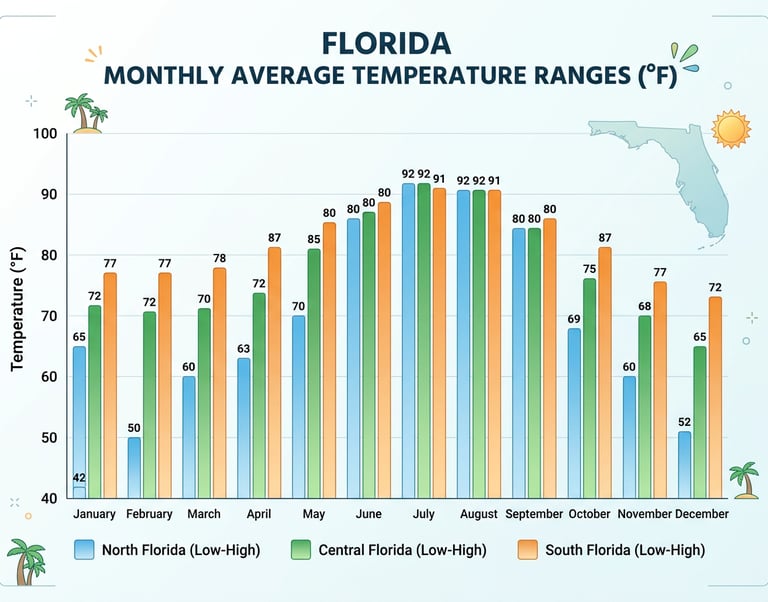
Region January High/Low - July High/Low - Annual Rainfall - Climate Type
Panhandle (Pensacola)
60°F / 43°F
91°F / 75°F
~65 inches
Humid subtropical
North Florida (Jacksonville)
64°F / 41°F
92°F / 73°F
~52 inches
Humid subtropical
Central Florida (Orlando/Tampa)
71°F / 49°F
92°F / 75°F
~52–54 inches
Humid subtropical
South Florida (Miami)
77°F / 60°F
91°F / 78°F
~62 inches
Tropical savanna
Based on NOAA 30-year climate normals. Temperatures represent average daily highs and lows.
Three Things This Table Tells You Worth Sitting With
North Florida winters are genuinely cool. Jacksonville averages January lows in the low 40s, and the Panhandle can drop into the 30s or even the 20s during cold fronts. January 2025 brought unusual snowfall to the Panhandle. North Florida residents sometimes own actual winter coats. This surprises people.
Summer temperatures are remarkably similar across the state. July highs in Pensacola, Jacksonville, Orlando, and Miami all cluster around 91–92°F. What varies more is overnight lows, humidity levels, and rainfall patterns — which is why South Florida feels different from North Florida in summer even when the thermometer reads similar numbers.
Pensacola gets significantly more rain than the rest of Florida. The western Panhandle is one of the wettest areas in the eastern United States, receiving rainfall totals more comparable to the Gulf Coast of Mississippi than to Miami.
Florida's Four Unofficial Seasons
Locals have their own seasonal vocabulary that tells the story better than any calendar.
The Perfect Season (November – April)
This is why people move here.
Comfortable highs in the 70s–80s across most of the state. Lower humidity. Reliably clear skies. The kind of weather that makes outdoor dining, morning beach walks, kayaking, farmers markets, and golf feel almost effortless. Snowbirds arrive. Festivals multiply. People from everywhere else text you photos of their snow.
For South Florida and the Keys, this season also brings the cooler, drier air that makes the tropics feel genuinely pleasant rather than oppressive. For North Florida, it means actual sweater weather some mornings and the occasional need for a jacket after dark.
This six-month stretch is what wins the long-term argument for Florida living.
Warm-Up Season (May)
May is Florida's transition month, and it has a particular character worth understanding before you experience it.
The mornings still feel pleasant. By afternoon, you notice the humidity has returned — not aggressively yet, but unmistakably. Afternoon thunderstorms begin making appearances, first sporadically, then with increasing regularity. In South Florida, the wet season officially begins in May. In Central and North Florida, it arrives by June.
May is the month that separates people who checked the weather online before moving from people who actually experienced it.
Hot and Stormy Season (June – September)
Welcome to Florida summer. The version of this season that requires honest description.
Temperatures across most of the state push into the low-to-mid 90s daily. Humidity becomes a physical presence rather than a background fact. The heat index — which combines actual temperature with humidity to calculate what it feels like to the human body — regularly reads 100–110°F or higher in the afternoon. Afternoon thunderstorms arrive with the regularity of a scheduled event.
This is also the season when Florida shows you its wild side: dramatic lightning shows, tropical downpours that drop an inch of rain in 30 minutes, and the occasional waterspout visible offshore.
Locals adapt. Morning outdoor activities. Air conditioning expertise. Strategic scheduling. Pools, springs, and waterways become the primary recreational infrastructure. And within a year or two, most residents develop a genuine fondness for the drama of a good Florida summer storm watched from a covered porch.
Reward Season (October)
October deserves its own category because it's that good.
The humidity begins dropping in the first weeks of the month. Temperatures moderate. The afternoon storm pattern breaks. October in Florida can produce some of the most beautiful weather of the year — warm days, comfortable evenings, lower humidity, and the particular golden quality of light that photographers know means the season has genuinely changed.
Residents who have survived August and September emerge blinking into October like people who have earned something. Which they have.


Month-by-Month Florida Weather Guide
January
January in a sentence: Florida's most reliably pleasant winter month — mild temperatures across most of the state, low humidity, abundant sunshine, and the full arrival of snowbird season.
January is frequently cited as one of Florida's most genuinely pleasant months — and it delivers on that reputation across most of the state.
In Central and South Florida, expect highs in the low-to-mid 70s with overnight lows in the upper 40s to mid-60s depending on how far south you are. Humidity is low by Florida standards. Sunshine is abundant. The beaches are active, the restaurants are full, and outdoor living is as close to effortless as Florida gets.
In North Florida, January is meaningfully cooler. Jacksonville averages January highs in the mid-60s with lows around 41°F. The Panhandle averages highs around 60°F and lows in the low 40s. Cold fronts push down periodically, and temperatures can dip below freezing on the coldest nights.
This is peak snowbird season statewide. Golf courses, parks, and outdoor markets are bustling. If you're visiting Florida for the first time in January, you'll understand within approximately 48 hours why so many people made this decision.
February
February in a sentence: Similar to January and often slightly warmer — wildflowers begin appearing, outdoor events increase, and many newcomers say out loud for the first time, "Wait. This is winter?"
February mirrors January's character and often arrives slightly warmer. Native wildflowers begin appearing in the interior. The natural landscape, still green from the previous year's rains, starts showing signs of spring — though spring in Florida is more of a feeling than a dramatic transformation.
The outdoor event calendar fills noticeably in February. Festivals up and down both coasts, winter strawberry season in the Plant City area near Tampa, and a general community energy that comes from everyone being outside make February a month worth being outdoors for.
March
March in a sentence: Florida's showpiece month — warm but not hot, low humidity, beautiful beach weather, and the kind of conditions that make visitors start researching real estate.
If Florida could choose a month to show off to skeptics, March would be the one it showed them.
Temperatures across most of the state are warm but not hot — highs in the upper 70s to low 80s across Central and South Florida, with North Florida still delivering comfortable weather in the mid-70s. Humidity remains low. Rainfall is light. Beach conditions are excellent. The freshwater springs — crystal-clear and a constant 68°F — are at their most inviting.
March is also spring break season, which means popular beach communities and tourist destinations see significant visitor traffic. Year-round residents learn to navigate March strategically. First-time visitors arrive at the peak of what Florida can offer.
April
April in a sentence: Warm but not oppressive, low humidity, perfect beach and outdoor conditions — for many Florida residents, April is the single best month of the year.
April frequently wins debates among Florida residents about the single best weather month.
Highs sit comfortably in the low-to-mid 80s. Humidity remains lower than what's coming. Rainfall is still light. Afternoon thunderstorms haven't yet established their daily summer pattern. The Gulf and Atlantic water temperatures are warming toward genuinely inviting swimming conditions. Outdoor activities of every kind are accessible without requiring the heat management strategies that July demands.
April is also the month when snowbirds begin heading north, which residents of heavily seasonal communities quietly appreciate. Roads thin out. Restaurants return to regular wait times. The state settles into a comfortable in-between moment before the wet season arrives.
May
May in a sentence: Florida's most transitional month — pleasant mornings that gradually give way to rising humidity, returning afternoon storms, and the first honest preview of what summer is going to be.
May is Florida's most transitional month, and it's worth understanding before you live through it.
The first weeks often still feel April-like. Then, usually somewhere in the second half of the month, something shifts. The mornings stay pleasant but the afternoons start delivering on summer's promise. Humidity climbs. Thunderstorms begin appearing — first occasionally, then regularly. By late May, the wet season is either beginning or approaching depending on where in the state you are.
May is also the month that brings lovebugs — the small, harmless insects that swarm in mating pairs twice a year (late April to May, and again in August-September). They coat your car and need to be washed off promptly to protect your paint. Every Florida resident has an opinion about lovebugs. None of those opinions are particularly warm.
Air conditioners get switched on in May and don't come back off until October. That is the honest May story.
June
June in a sentence: Summer arrives for real — daily highs climbing into the low 90s, heat index values pushing past 100°F, afternoon thunderstorms become near-daily events, and hurricane season officially begins June 1.
June is the calendar's announcement that summer has fully arrived, and Florida takes that announcement seriously.
Temperatures climb into the low-to-mid 90s. Heat index readings push well above 100°F during afternoon hours. Afternoon thunderstorms become a near-daily occurrence — the sea breezes from the Gulf and Atlantic converge over the peninsula, rising air triggers convective activity, and by 3 or 4 p.m. the sky puts on a show that ranges from dramatic to alarming depending on your comfort level with lightning.
Hurricane season begins June 1, though historically June is one of the less active months of the season.
Early morning outdoor activity — before 10 a.m., ideally before 9 — is the strategy that separates residents from recent arrivals.
July
July in a sentence: Florida's most demanding month — daily highs around 91–92°F statewide, heat index often exceeding 105°F, near-daily afternoon thunderstorms, and humidity at its annual peak; mornings remain beautiful, evenings offer spectacular lightning displays, and Gulf water temperatures hit the upper 80s.
Let's be direct: July is Florida's most demanding month for anyone not entirely at peace with heat and humidity.
Daily highs hover around 91–92°F statewide. Heat index values during peak afternoon hours routinely reach 105–112°F. Afternoon thunderstorms are daily events. Humidity is as present as furniture. The Florida summer experience, for better or worse, is fully delivered in July.
What July also offers: some of the most beautiful mornings you'll experience anywhere — warm, green, and clear before the day heats up. Long evenings with spectacular cloud-to-cloud lightning visible from 20 miles away. Gulf water temperatures in the upper 80s. And the particular camaraderie of people who've figured out how to live well in conditions that would have seemed impossible to them three years ago.
July is not the month to bring visiting relatives from Minnesota if you're trying to convince them that Florida is wonderful. Bring them in November. Show them July honestly later, after they've signed the lease.
August
August in a sentence: Florida's sustained peak of summer — matching or edging July for heat and humidity, daily afternoon thunderstorms continuing without pause, lovebug season returning, and — most usefully — the single best month to visit if you're seriously considering moving here.
August and July compete for Florida's hottest month designation, and the results are genuinely close. Most climate data gives the edge to August for sustained heat, while July often delivers more dramatic temperature spikes.
The afternoon thunderstorm pattern continues daily. Humidity reaches its annual high point. Florida averages over 1.4 million lightning strikes per year — the highest lightning density of any state — and August is one of the most active months. Lightning is not an abstract concept in Florida; it's a daily feature of summer life that residents take seriously and newcomers underestimate.
The second lovebug season arrives in August. No one particularly looks forward to this.
Here's something honest and valuable that belongs specifically in August's entry: if you're seriously considering moving to Florida, visiting in August is one of the most important things you can do. March shows you why people fall in love with this state. August shows you what the full commitment looks like. If you can live with August — if you find it manageable, or even interesting — you're probably going to be genuinely happy here long-term.
September
September in a sentence: August's close companion through most of the month, with subtle but real hints of relief arriving in the final week — and historically one of the most active months of hurricane season.
September begins as August's companion and gradually, toward the end of the month, starts offering small hints that relief is possible.
The afternoon thunderstorm pattern continues through most of the month. Temperatures remain in the low 90s. Humidity stays high. But around the third or fourth week, something subtle shifts — the mornings feel slightly less oppressive, the humidity backs off incrementally, and October begins to feel like a real possibility rather than a rumor.
September is historically one of the most active months of hurricane season. The combination of warm ocean temperatures and favorable atmospheric conditions makes September storms possible along any stretch of Florida coastline. This is the month when residents who got a little relaxed with their hurricane preparedness remember why the supplies exist.
October
October in a sentence: Florida's best-kept weather secret — humidity retreating, temperatures moderating, the landscape at its greenest from summer rain, thin crowds, and some of the most beautiful evenings of the year.
October is where Florida collects its debt from the people who survived August.
The first cold fronts of the season push down from the north in October, and when they arrive, the change in air quality is palpable. Humidity drops. The afternoons become comfortable rather than endurance challenges. Evenings invite outdoor dining in a way that hasn't been true since April. The landscape — lush and deeply green from five months of summer rain — looks its absolute best.
October crowds are thin. Accommodation prices are lower. Beaches are accessible without peak-season density. The water is still warm enough for extended swimming. And Florida's spectacular autumn sunsets are at their best.
This is October in Florida. Residents know it. Use that knowledge to your advantage.
November
November in a sentence: Florida's first full reward after summer — humidity gone, daytime highs in the mid-to-upper 70s across most of the state, cool sleeping weather, snowbirds arriving, and outdoor life fully restored.
If October is Florida's best-kept secret, November is its first full reward.
The humidity is gone. Daytime temperatures across Central and South Florida settle into the mid-to-upper 70s with overnight lows in the mid-to-upper 50s — ideal sleeping weather. North Florida goes slightly cooler, with highs in the low-to-mid 70s and evening temperatures that might prompt a light jacket. The Panhandle starts feeling genuinely autumnal.
Snowbirds begin arriving, which in most beach communities means the social energy and restaurant quality both improve considerably. Outdoor festivals return to the calendar. Residents who spent August and September largely inside re-emerge with the enthusiasm of people who have been patient and are ready to collect their reward.
November may be the month that most consistently surprises newcomers who arrive expecting a typical autumn and find instead something genuinely better.
December
December in a sentence: Mild and pleasant across most of Florida, outdoor Christmas festivals statewide, and the month that prompts visitors from colder climates to seriously reconsider their life choices — especially when locals are decorating palm trees instead of pine trees.
December in Florida is the month that makes people call their family members back in Wisconsin at 2 p.m. from the beach.
Temperatures across Central and South Florida remain mild — highs in the upper 60s to mid-70s, lows in the 50s to low 60s. North Florida is cooler, and the Panhandle can dip into the 40s at night with occasional cold fronts bringing significantly lower temperatures. Snow in the Panhandle, while rare, has happened — January 2025 being one recent example.
December in Florida looks different enough from December elsewhere that the decorations themselves take on a different quality. Christmas lights on palm trees. Holiday festivals held entirely outdoors. Visitors from northern states who packed heavy coats they never needed.
The outdoor lifestyle that Florida promises delivers fully in December, and for many residents it represents the state at its most enjoyable.
Understanding the Heat Index: Why "92°F" Doesn't Tell the Whole Story
Anyone who has spent a Florida summer knows that the number on the thermometer is only the beginning of the conversation.
Florida's summer humidity — relative humidity regularly in the 75–85% range during peak afternoon hours — significantly reduces the human body's ability to cool itself through perspiration. The result is what meteorologists call the heat index: the "feels like" temperature that combines actual temperature and humidity.
What Florida Heat Index Looks Like in Practice
Actual Temperature - Humidity - Feels Like
90°F
70%
104°F
92°F
80%
109°F
95°F
85%
119°F
These aren't worst-case scenarios. They're representative of a typical Florida summer afternoon.
Heat Index Safety Rules Florida Residents Live By
Move outdoor exercise and labor to early morning hours — before 9–10 a.m. whenever possible
Stay hydrated far more aggressively than you think you need to; the humidity makes you sweat without feeling like you're sweating
Take shade breaks seriously — heat exhaustion progresses faster than most people expect
Never leave children, pets, or medications in a parked vehicle — interior temperatures can exceed 130°F within minutes in direct summer sun
The heat index is also why experienced Florida residents have essentially no guilt about their air conditioning usage. In this climate, it's infrastructure, not indulgence.
Lightning: Florida's Most Underestimated Weather Reality
Here's a Florida weather fact that deserves more space than it usually gets: Florida averages over 1.4 million lightning strikes per year, with Central Florida's "Lightning Alley" — the corridor running roughly from Tampa to Titusville — recording the highest lightning density in the continental United States.
More than 3,000 cloud-to-ground lightning strikes occur in Florida on an average summer day. Florida also consistently records the highest number of lightning fatalities among all U.S. states, averaging around 10 deaths and 30 injuries annually. This is not a small-print footnote to Florida summer weather. It is a defining feature of it.
Lightning Safety Rules That Every Florida Resident Needs to Know
If you hear thunder, get off the water, off the golf course, and inside — immediately
Lightning can strike up to 10 miles from the nearest storm, including from what looks like clear sky nearby
Open fields, beaches, and bodies of water are the most dangerous positions during a storm
Trees are not shelter — they're lightning targets
A vehicle with the windows up is generally safe; open structures, covered pavilions, and open boats are not
The standard "Flash-to-Bang" rule: count the seconds between lightning flash and thunder, divide by 5 — that's the distance in miles. Under 30 seconds means get inside now.
Residents develop good instincts about this over time. The afternoon radar check becomes second nature. Don't underestimate Florida lightning because it happens every day. That frequency is exactly why it deserves respect.
The Florida Sun Is a Different Conversation
Related to but separate from heat: Florida ranks third among all U.S. states for average UV index, behind only Hawaii and Arizona. During Florida summer, midday UV levels regularly reach 11 or higher — classified as "extreme" by the EPA and the World Health Organization. At this level, unprotected skin can begin burning in as little as 10–15 minutes.
What "Extreme UV" Means for Daily Life in Florida
SPF 30 or higher sunscreen, worn daily and reapplied throughout the day, is the standard for Florida residents who are paying attention — not just at the beach
Sunglasses with UV protection matter here in a way they may not have at your previous address
A hat becomes part of the outfit, not an accessory
The UV index doesn't care whether it's cloudy — clouds filter some UV, not all of it
Florida's rate of skin cancer is above the national average. The connection is direct and preventable.
Florida Water Temperatures: A Practical Swimming Guide
One of Florida's genuine advantages is that the water is swimmable for a significant portion of the year — on both coasts. But temperatures vary meaningfully by season and by which coast you're on.
Month - Gulf Coast (Tampa area) Atlantic Coast (Miami area)
January
63–65°F
73–75°F
April
73–76°F
77–79°F
July
85–88°F
83–85°F
October
78–81°F
79–82°F
Gulf vs. Atlantic: What the Difference Means Practically
The Gulf Coast is warmer than the Atlantic in summer due to the shallower, more enclosed nature of the Gulf of Mexico. Gulf water in July and August can feel like a warm bath — comfortable or excessive depending on your preference. The Atlantic coast runs slightly cooler in summer, kept in check by the Gulf Stream current running close to the Southeast Florida shoreline.
Spring (March–May) offers some of the best conditions for swimming in Florida — water temperatures warm enough to be comfortable without yet reaching August's bath-level warmth, air temperatures not yet at summer extremes, and generally lighter crowds than peak winter or summer season.
Hurricane Season: What Residents Actually Experience
Hurricane season runs June 1 through November 30. That's six months — which sounds alarming written plainly — and it requires context that the number alone doesn't provide.
The reality that most Florida residents describe: most years, most of Florida is not significantly impacted by a hurricane. The vast majority of named storms stay offshore, weaken before reaching the coast, or make landfall in a different part of the state. What hurricane season actually looks like for most Florida residents most years is: monitoring forecasts, keeping supplies on hand, knowing your evacuation zone, and living your life.
That said, when a major storm does affect your area, the consequences can be severe. The preparation that feels unnecessary 95% of the time is exactly what matters during the 5% that counts. Florida residents take hurricane season seriously not because they're constantly afraid, but because they've internalized the discipline of preparation and moved on. It's the same practical approach that people in Tornado Alley have with tornado season.
The Most Important Hurricane Season Basics
Know your evacuation zone before June 1 — find it at floridadisaster.org/knowyourzone
Have a 7-day emergency supply kit assembled and maintained
A hurricane watch means conditions are possible in 48 hours — time to prepare
A hurricane warning means conditions are expected in 36 hours — time to execute your plan
Peak season is mid-August through mid-October — the period of warmest ocean temperatures and most favorable conditions for storm development
The category number measures wind speed; storm surge is often the more dangerous threat
For a complete hurricane preparedness guide specific to 2026, see our companion article: Florida Hurricane Season 2026 Explained: A Practical Guide for Residents.


The Biggest Weather Surprises for New Florida Residents
Every newcomer has their weather moments. These come up most consistently.
The Humidity
Everyone is warned about it. Almost no one fully processes it until they're standing in a Publix parking lot at 2 p.m. in August wondering if this is what it always feels like. It is. And then, around month six or eight, you adapt more than you thought you would. Most residents who struggled through their first summer report that by the second or third, it's simply part of life.
The Lightning
The frequency, the scale, and the seriousness of Florida thunderstorms catch many newcomers off guard. A storm that would be the weather event of the week elsewhere might happen four times in a single July. Respect the lightning. Always.
The North-South Temperature Gap in Winter
New residents who expected uniform "Florida weather" everywhere are consistently surprised to find that Jacksonville and Pensacola can be sweater-cold while Miami is in shorts. Research the specific region you're considering — the difference is substantial.
How Good October Is
Nobody warns you about October adequately. It's consistently one of the best months of the year, with summer's humidity gone, the landscape at its greenest, and the light taking on a quality that makes everything look better. If you arrive in August and struggle, hold on. October is coming.
The Afternoon Storm Pattern
The predictability of summer storms surprises people — both how reliable they are and how quickly they arrive and leave. Most pass within 30 to 60 minutes. Planning your outdoor day around this pattern is a skill Florida residents develop within their first summer.


Florida Weather Myths vs. Reality
Myth: Does Florida Stay Hot All Year?
The short answer: No — North Florida and the Panhandle experience genuinely cool winters, and even Central Florida can have chilly nights.
North Florida and the Panhandle experience genuinely cool winter weather, with temperatures regularly in the 40s at night and cold fronts that occasionally push into the freezing range. Even Central Florida can have January nights in the upper 40s that feel cold once you've acclimated to the climate. Tallahassee, in the Panhandle, occasionally sees light frost and temperatures in the 20s during strong cold outbreaks. The "always hot" description applies most accurately to South Florida and the Keys.
Myth: Does It Rain All Day in Florida?
The short answer: No — Florida's summer rain is typically a concentrated afternoon storm that passes within an hour, not all-day gray drizzle.
Florida rainfall is predominantly convective — triggered by heat and sea breeze interactions rather than frontal systems. Summer storms typically build in the afternoon, deliver significant rainfall in a short and often dramatic period, and move through within 30 minutes to an hour. Most Florida summer days have entirely clear, beautiful mornings and at least some clear afternoon and evening time. Carrying a small umbrella in your car handles the rest.
Myth: Do Hurricanes Constantly Hit Florida?
The short answer: No — Florida has significant hurricane risk, which requires consistent preparation, but most residents most years do not experience a direct hurricane strike.
Florida has been struck by more hurricanes than any other U.S. state — that's a fact — but the word "constantly" doesn't fit the daily experience of most residents across most years. What Florida has is sustained hurricane risk that requires sustained preparation. Those are different things. The consistent advice from longtime Florida residents: prepare every year as if it matters, because eventually it does, and then live your life without spending the rest of the season afraid.
Myth: Does All of Florida Have the Same Climate?
The short answer: No — Florida's climate varies dramatically from north to south, and the region you choose to live in matters enormously.
A resident of Key West and a resident of Pensacola experience genuinely different climates — different temperatures, different winter character, different rainfall patterns, and in some ways different seasons entirely. The 500+ mile span of the Florida peninsula covers the transition from humid subtropical to tropical climates, with meaningful variation in between. The region you choose to live in will significantly affect your day-to-day experience of Florida weather.
Best Florida Weather by Activity
Best Weather for Beach Visits
March through May and October through November — warm water, lower crowds, comfortable air temperatures, and the pleasant lighting of shoulder season. April and October offer the best combination of warmth and accessibility.
Best Weather for Outdoor Sports and Recreation
November through April — peak season for golf, tennis, hiking, biking, paddling, and festivals statewide. The entire dry season is excellent for any outdoor pursuit.
Best Weather for Water Sports on the Gulf Coast
June through September — water temperatures in the mid-to-upper 80s on the Gulf, warm evenings, and the particular pleasure of warm-water swimming. Just plan around afternoon thunderstorms.
Best Weather for Budget-Friendly Florida Visits
Late August through October — temperatures are still warm, the water is still excellent, crowds are significantly lower, and hotel rates reflect the off-peak status. Monitor hurricane forecasts during this window, but for those who follow the weather, late September and October offer some of the best value in Florida tourism.
Best Time to Assess Whether Florida Is Right for You
Visit in both March and August. March shows you why people move here. August shows you what they signed up for. Both visits together give you an honest picture that neither one alone can provide — and that no amount of reading online can fully replace.
Final Thoughts
Florida weather isn't perfect. The summers are genuinely demanding in ways that take honest adjustment. July and August will test your relationship with heat, humidity, and the concept of going outside voluntarily at 2 p.m. At some point, you will get caught in a thunderstorm that appeared from a nearly clear sky, and you will understand why Florida residents check radar apps the way people elsewhere check email.
But Florida also offers something that is hard to find and easy to underestimate until you've experienced it: the freedom that comes with weather that doesn't trap you indoors for months at a time. A January that feels like early spring. An October that makes you feel like the state is showing off just for you. A daily outdoor life that reshapes habits, improves health, and changes what a regular Tuesday feels like.
Bring sunscreen — SPF 30 or higher, and actually apply it. Keep a small umbrella in the car year-round. Respect the lightning. Drink more water than you think you need. Download the radar app before you need it.
The weather here is not perfect. But it is, for most people who understand it honestly, something they grow genuinely glad to live with.
Florida Current Tip: Before making any major Florida decision — moving, retiring, buying a home — visit twice: once in March and once in August. The March visit explains the appeal. The August visit confirms whether you can live with the full picture. Both matter, and the combination gives you something no amount of research online can fully replace.
Florida Current covers weather, lifestyle, outdoor life, and everything that comes with living in the Sunshine State. Browse our Florida Living section for regional guides, seasonal activity calendars, and practical advice from people who actually live here.
Florida native Luana B. Gann brings more than 30 years of publishing, editing, and journalism experience to Florida Current. With a deep appreciation for the Sunshine State’s culture, lifestyle, and ever-changing landscape, she is dedicated to helping readers discover what’s new, noteworthy, and uniquely Florida.








CONTACT
Reach out for questions or feedback anytime.
contact@FLAcurrent.com
© 2026. All rights reserved.