Moving to Florida With Kids? Here's What You Need to Know About Schools
Luana B. Gann, Editor
6/7/2026


Quick Answer — Florida Schools Florida has 67 public school districts (one per county), plus one of the most expansive school choice systems in the country — including charter schools, magnet schools, Florida Virtual School, and scholarship programs that can fund private school or homeschooling for eligible families. Children must be enrolled within 30 days of establishing Florida residency. You'll need proof of age, immunization records, and proof of address to get started.
Table of Contents
If you're moving to Florida with children, the school question lands fast. Before the boxes are unpacked and before you've found the nearest Publix, someone in your house is asking: What school will I go to?
It's a fair question — and a more interesting one than you might expect. Florida's education landscape is not a simple "you live here, your kid goes there" system. The Sunshine State has built one of the most expansive school choice frameworks in the country, which means families arriving here have options that genuinely didn't exist where they came from. Public schools, charter schools, magnet schools, virtual school, private school scholarships, homeschooling — it's a real menu, not a formality.
That said, navigating it for the first time can feel like reading a map in a language you mostly speak. We're here to make it readable.
This article covers what every family moving to Florida needs to know about schools: how the system works, how to enroll, what choices are available, how to evaluate schools, and what Florida offers your kids beyond the classroom — including some college-bound opportunities that quietly set Florida students apart.
How Florida's School System Is Set Up
One State, 67 Districts
Florida's public school system is organized into 67 school districts — one for every county. Each district is governed by an elected School Board and managed by a Superintendent. The Florida Department of Education (FLDOE) sets statewide standards, oversees accountability, and administers scholarship programs, but day-to-day operations live at the district level.
This means that your experience with Florida public schools will depend significantly on which county you live in. St. Johns County schools operate differently from Miami-Dade County schools. School calendar dates, uniform policies, extracurricular offerings, and local funding levels all vary. When people say "Florida schools" as if it's one monolithic thing, they're painting with a very wide brush.
Florida's Academic Standards
Florida uses the B.E.S.T. Standards (Benchmarks for Excellent Student Thinking), adopted in 2020, which set statewide expectations for what students should know and be able to do in English Language Arts and Mathematics at each grade level. Science, social studies, and other subject standards are also set at the state level.
Florida replaced its long-running FCAT standardized tests with the FAST assessments (Florida Assessment of Student Thinking) beginning in the 2022-23 school year. FAST tests ELA and Math in grades 3 through 10 and is designed to measure both achievement and individual learning growth — how much a student improves over time, not just where they land on a score scale.
School Structure: Grades and Levels
Florida public schools follow a standard K-12 structure, though how those grades are organized into schools (K-5, K-8, 6-8, 9-12, etc.) varies by district. Most districts use a traditional elementary/middle/high school model:
Level- Grades - Typical Ages
Voluntary Pre-K (VPK)
Pre-K
Age 4
Elementary School
K–5
Ages 5–11
Middle School
6–8
Ages 11–14
High School
9–12
Ages 14–18
Compulsory school age in Florida: 6 through 16. Children must be enrolled in school (public, private, or an approved homeschool program) once they turn 6.
The Kindergarten Age Cutoff
Florida's kindergarten entry cutoff date is September 1. Your child must turn 5 on or before September 1 of the school year in which they enroll in kindergarten. If your child turns 5 on September 2nd, they wait another year — no exceptions through the public school system, though some private schools have more flexibility.
Florida Current Tip: Florida offers free Voluntary Pre-K (VPK) to every 4-year-old in the state — regardless of income. This is one of the most genuinely useful and underutilized benefits available to Florida families. It's a high-quality, no-cost pre-kindergarten program available at both school-based and private provider sites. Apply through your county's Early Learning Coalition. Don't leave this on the table.


Enrolling Your Child: What to Bring and What to Expect
The 30-Day Rule
If you're a new Florida resident with school-age children, you need to enroll them within 30 days of establishing Florida residency — the same timeline as your driver's license transfer. Most districts will accommodate mid-year enrollment; schools are accustomed to Florida's high mobility rate.
Where to Enroll
For most Florida families, the enrollment process starts at the school your child is zoned for based on your home address. You can find your zoned school through your district's website or through FLDOE's Know Your Schools portal. If you're interested in a charter school, magnet program, or school choice option, those often have separate application processes (more on that in the next section).
What to Bring to Enrollment
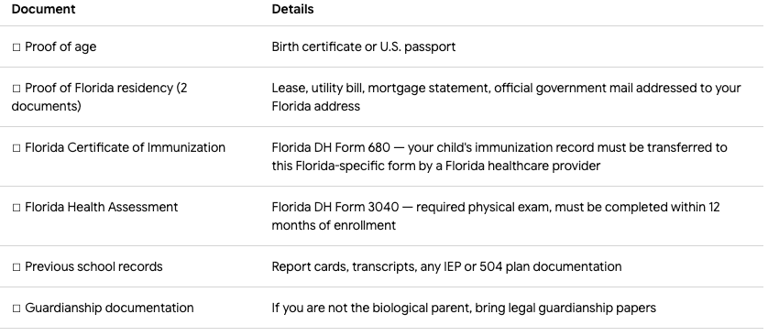
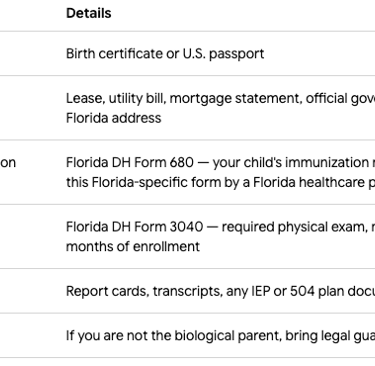
Every district has its own enrollment packet, but Florida-wide, here's what you'll need at minimum:
Florida Current Note: The immunization form is the one that catches most families off guard. Florida uses its own Certificate of Immunization (DH 680), and your child's out-of-state immunization records must be converted to this form by a Florida-licensed healthcare provider before or shortly after enrollment. Schedule a Florida pediatrician visit early — this form cannot be self-prepared, and some schools will give you a short grace period but not indefinitely.
Special Education and IEP Transfer
If your child has an Individualized Education Program (IEP) or 504 Plan from their previous state, bring those documents to enrollment. Florida schools are required to honor existing IEPs and provide services within 30 days of enrollment while they develop a new Florida IEP. Request an IEP meeting promptly — don't wait for the school to initiate it.
For more on your rights under Florida's special education system, the Florida Department of Education's Exceptional Student Education resources are the official starting point.
English Language Learners
Florida has a large and well-established ELL (English Language Learners) infrastructure. If English is not your child's primary language, they'll be assessed through the WIDA ACCESS test and receive appropriate language support services. Florida's multilingual school environment — particularly in South Florida — means support systems here are often better developed than in many other states.


Florida's School Choice Menu: Every Option Explained
This is where Florida genuinely stands out. Most states offer public schools with a smattering of charter options. Florida has built something considerably broader — and understanding your options before you commit to a neighborhood or county can meaningfully shape your family's experience here.
Traditional Public Schools
Your baseline option: free, zoned, and funded by local and state taxes. Quality varies by district, school, and even individual teachers — as it does everywhere. The school grading system (covered in the next section) is your tool for evaluating specific schools. Florida's best public school districts are genuinely excellent. Its lowest-performing ones are not, and you deserve an honest map.
Charter Schools
Florida charter schools are public schools — free to attend, funded with public dollars — but they operate independently of the traditional district system under a charter (contract) granted by the local school board or a state university. They can specialize in specific academic approaches, teaching philosophies, or focuses like STEM, arts, or classical education.
Florida has one of the largest charter school sectors in the country, with more than 700 charter schools statewide. Quality, as with traditional public schools, varies widely. A charter school's grade through Florida's accountability system is public information — use it.
Key things to know about Florida charter schools:
Enrollment is typically through a lottery when applications exceed available seats — apply early
Waitlists are common at high-performing charters
They are not guaranteed to continue operating — charter schools can and do close
Find the Directory of Florida Charter Schools at fldoe.org
Magnet Schools
Magnet schools are specialized public schools within the traditional district system, offering focused curricula in areas like STEM, performing arts, International Baccalaureate (IB), or dual-language immersion. They typically draw students from across a district rather than a specific attendance zone, often through a competitive application or lottery process.
Florida has strong magnet programs in many of its larger urban districts. If your child has a specific academic passion or learning style, it's worth researching whether your district has a magnet program that fits.
Florida Virtual School (FLVS)
Florida Virtual School (FLVS) is a free, fully accredited, state-funded virtual school available to all Florida K-12 students. It offers both full-time enrollment and individual course enrollment — meaning your child can attend a traditional school while taking specific courses through FLVS that their school doesn't offer.
FLVS is particularly valuable for:
Students in competitive athletics or performing arts with scheduling demands
Accelerated learners who want to take courses beyond their grade level
Students who learn better at their own pace
Families who want to supplement their child's traditional education
FLVS courses are taught by Florida-certified teachers, count toward a standard diploma, and in many cases can be completed faster than a traditional semester if the student is motivated.
Private Schools
Florida has more than 3,500 private schools serving K-12 students. Here's the headline: Florida's scholarship programs mean private school is within reach for far more families than most people realize. You don't need to be wealthy to access private school in Florida — but you do need to know the programs exist and how to apply.
The Florida Department of Education's Private School Directory allows you to search by county, grade, and religious affiliation.
Florida's K-12 Scholarship Programs
Florida has invested significantly in school choice scholarships. The major programs, all managed through Step Up For Students:
Family Empowerment Scholarship (FES-EO — Education Options):
Florida's universal school choice program
Available to all Florida K-12 students regardless of income
Funded as an Education Savings Account (ESA) — money goes directly to families to use for approved educational expenses including private school tuition, curriculum, tutoring, and more
Award amounts vary but are funded based on the per-pupil amount the state would have spent on that child in public school
Apply at stepupforstudents.org
Family Empowerment Scholarship for Students with Unique Abilities (FES-UA):
For students with disabilities (IEP or 504 plan)
Can be used for specialized private school, therapies, equipment, and other qualifying expenses
Higher award amounts than the general FES-EO program
Hope Scholarship:
Available to public school students who have experienced bullying, harassment, or violence at school
Funds attendance at a private school or transfer to another public school
New Worlds Scholarship:
$500 ESA for K-5 students struggling with reading or math
Can be used for tutoring, supplemental materials, and educational programs
Florida Current Tip: If you're moving to Florida and considering private school, don't assume you can't afford it before you look into the FES-EO scholarship. Florida's school choice system is more expansive than what most families encounter in other states. Research before you decide.
Home Education (Homeschooling)
Florida homeschooling requirements are relatively straightforward compared to many states:
File a Notice of Intent with your county school district within 30 days of beginning homeschooling (or within 30 days of establishing Florida residency if already homeschooling)
Maintain a portfolio of educational records — samples of work, reading lists, materials used
Annual evaluation — one of several accepted methods: portfolio review by a Florida-certified teacher, standardized test, Florida assessment, professional evaluation, or a state-approved correspondence program evaluation
Florida does not require a specific curriculum, parental teaching certification, or set daily hours. The flexibility is genuine. The FLDOE Home Education page outlines all requirements.

How Florida Grades Its Schools — and How to Use That
The A–F School Grading System
Florida grades every public school and every public school district annually on an A through F scale. This is one of the most transparent school accountability systems in the country, and it is a genuinely useful tool for families choosing where to live or which school to request.
What goes into a school's grade:
Factor - Weight
Student achievement (FAST test scores)
~30%
Learning gains (individual student improvement)
~30%
Learning gains of lowest-performing 25% of students
~10%
Graduation rate (high schools)
~10%
College/career readiness (high schools)
~20%
Note that learning gains — how much each student improved over the prior year — count for 40% of a school's grade. This is intentional: a school serving a challenging student population can earn an A if it's moving students forward significantly, even if raw test scores aren't at the top. It rewards growth, not just starting-line advantage.
Annual school and district grades are published at fldoe.org/accountability and at the Know Your Schools portal.
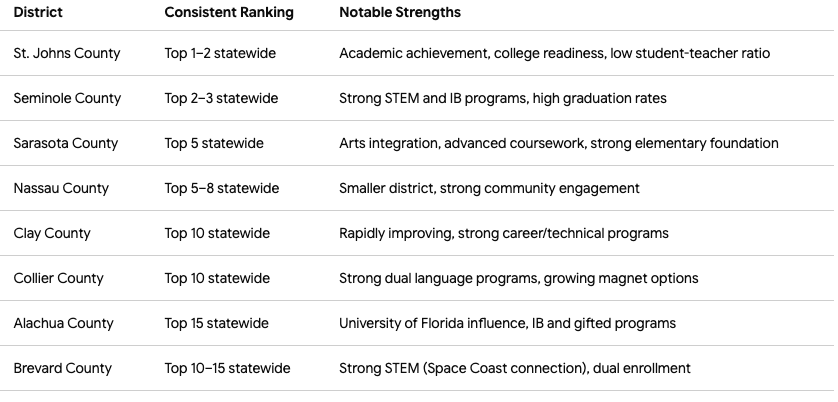
Consistently Highest-Rated Florida School Districts
Based on Florida's district grading system and consistent third-party rankings:
Sources: FLDOE District Grades, Niche.com, SchoolDigger, US News & World Report school rankings, 2024-25
Florida Current Note: Rankings are one data point, not a verdict. A school ranked B in a challenging district may be doing more impressive instructional work than an A school in a high-income suburb. Look at individual school grades, visit campuses, and talk to parents in the community before making housing decisions based solely on district rankings.
What the Rankings Don't Tell You
District rankings heavily correlate with median household income — wealthier districts score higher almost everywhere in the country, and Florida is no exception. That said, Florida's accountability system does a better job than most of surfacing schools that are genuinely improving and serving students well across income levels. Use Niche.com alongside FLDOE data for a more complete picture, and cross-reference specific school grades, not just district averages.

Beyond the Classroom: Scholarships, Dual Enrollment & College Planning
Florida Bright Futures: One of the Best State Scholarship Programs in the Country
If your family is in Florida for high school, Bright Futures is a big deal. Florida's merit-based scholarship program funds college tuition at Florida public universities and colleges for qualifying graduates — and the awards are substantial.
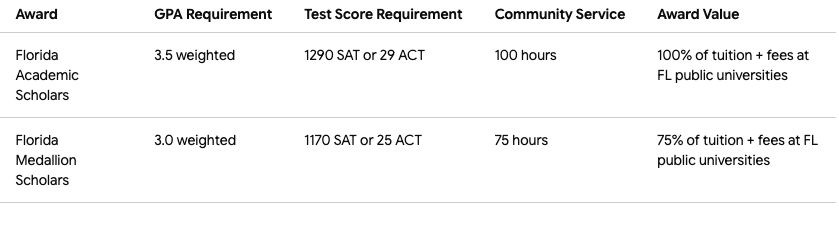
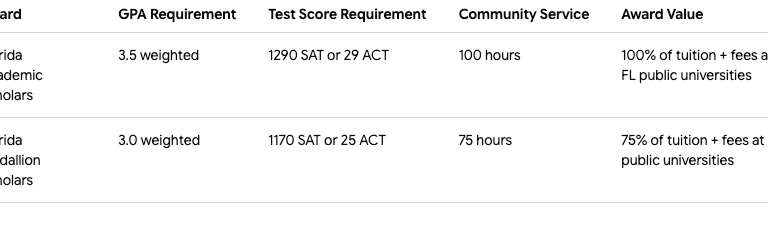
Bright Futures Award Tiers (2025-26):
Note: Award values are subject to legislative funding each year. Verify current amounts at floridastudentfinancialaidsg.org.
Critical timing: Community service hours begin accruing in 9th grade. Families who move to Florida in 10th, 11th, or 12th grade may find their student behind on hours. Start tracking immediately upon arrival and contact your school's guidance counselor on day one to understand the Bright Futures requirements and timeline.
Dual Enrollment: Florida's Underrated College Head Start
Florida has one of the strongest dual enrollment programs in the country. High school students (typically 10th-12th grade) can take courses at Florida College System institutions — completely free of charge — and earn both high school and college credit simultaneously.
This is not a niche program. Florida students regularly graduate high school with an Associate of Arts degree already in hand, entering university as juniors. The cost savings are significant: two years of Florida college tuition, avoided entirely.
Dual enrollment is available through your school district in partnership with local state colleges. Ask your district's guidance office about eligibility, course options, and how credits transfer to Florida's public universities.
Advanced Placement and International Baccalaureate
Florida has robust AP (Advanced Placement) course offerings across the state, and a strong network of International Baccalaureate (IB) programs, particularly in larger urban and suburban districts. IB programs offer globally recognized, rigorous curricula at the middle and high school levels.
If your child is in an IB program in another state, research whether a Florida school in your target district or county offers a comparable program — and apply early, as IB programs often have competitive enrollment.
Florida's College System: What Comes After
Florida is home to the State University System (SUS), a network of 12 public universities including the University of Florida (Gainesville), Florida State University (Tallahassee), University of South Florida (Tampa), University of Central Florida (Orlando — one of the largest universities in the country by enrollment), and Florida International University (Miami).
Florida also maintains the Florida College System — 28 state colleges offering affordable two-year and four-year programs. Between Bright Futures scholarships, dual enrollment credits, and in-state tuition rates, a Florida K-12 education can lead to a remarkably affordable path to a degree.
For college planning resources, FloridaShines.org — Florida's statewide student articulation and transfer service — is the central hub for understanding how credits transfer across the Florida system.
❓ Florida Schools FAQ
Q: How do I enroll my child in a Florida public school when we move? Start at your county school district's website to find your zoned school based on your address. Bring proof of age (birth certificate or passport), two proofs of Florida residency, a Florida Certificate of Immunization (DH 680 form), a Florida Health Assessment (DH 3040 form), and your child's previous school records. Enroll within 30 days of establishing Florida residency. Individual schools handle enrollment directly in most districts.
Q: What is the Florida Certificate of Immunization and how do I get one? The Florida DH Form 680 is Florida's required immunization record. Your child's out-of-state immunization records must be transferred to this Florida-specific form by a Florida-licensed healthcare provider. You cannot self-prepare this form. Schedule a pediatrician visit shortly after arrival — most schools will give a short grace period for new enrollees but will require the form promptly.
Q: What is the Family Empowerment Scholarship in Florida? The Family Empowerment Scholarship (FES-EO) is Florida's universal school choice program, available to all K-12 Florida students. It provides an Education Savings Account funded with a portion of the per-pupil public education dollars that would have been spent on that child, which families can use for private school tuition, curriculum, tutoring, and other approved educational expenses. Apply at stepupforstudents.org.
Q: What is the best school district in Florida? St. Johns County (northeast Florida, near Jacksonville) and Seminole County (Central Florida, near Orlando) consistently rank as Florida's top two public school districts by Florida's state accountability grades. Sarasota, Nassau, and Collier counties also consistently rank in the top tier. Rankings correlate significantly with household income and should be considered alongside individual school grades for specific campuses.
Q: Does Florida have good homeschooling laws? Florida is considered a homeschool-friendly state. Requirements include filing a Notice of Intent with your county school district, maintaining a portfolio of educational records, and completing an annual evaluation (with several approved methods, including a portfolio review by a certified teacher or standardized testing). No specific curriculum, parental certification, or mandated daily schedule is required. See fldoe.org/schools/school-choice/home-edu/ for official requirements.
Q: What is Florida Bright Futures? Bright Futures is Florida's merit-based college scholarship program. The Florida Academic Scholars award covers 100% of tuition and fees at Florida public universities for students with a 3.5 weighted GPA, 1290 SAT or 29 ACT, and 100 community service hours. The Florida Medallion Scholars award covers 75% for students with a 3.0 GPA, 1170 SAT or 25 ACT, and 75 service hours. Community service hours begin accruing in 9th grade — start tracking immediately if your child is high-school age.
Q: Can my Florida high schooler take free college courses? Yes. Florida's Dual Enrollment program allows eligible high school students to take courses at Florida College System institutions at no cost to the family. Students earn both high school and college credit. Many Florida students graduate high school with an Associate of Arts degree already completed. Ask your school district's guidance counselor about eligibility and enrollment.
Q: How does Florida grade its public schools? Florida's Department of Education assigns A through F grades to every public school and district annually. The grade is based on a formula weighing student achievement (FAST test scores), individual learning gains, graduation rates (high schools), and college/career readiness. Annual grades are published at fldoe.org and at knowyourschoolsfl.org. Individual school grades — not just district averages — are the more useful comparison tool.
📚 More From Florida Current
The school question is usually the first one, but it's far from the last. Here's where to go next:
The Florida New Resident Checklist: 25 Things to Do After the Moving Truck Leaves — Schools are on the list — so is everything else your first Florida month demands
What Does It Really Cost to Live in Florida? — Budgeting for Florida school costs (supplies, uniforms, activity fees, sports) alongside the full family picture
Everyday Life in Florida: What It Actually Feels Like to Live Here — What daily life looks like once the logistics are handled and you're just living it
Wild Florida: What's Out There, What's Harmless, and What Deserves Your Respect — Because sooner or later, one of your kids will come home with a question about the thing in the backyard
Was this helpful? Share it with a family making the move to Florida — school planning is always better with a head start.
Florida native Luana B. Gann brings more than 30 years of publishing, editing, and journalism experience to Florida Current. With a deep appreciation for the Sunshine State’s culture, lifestyle, and ever-changing landscape, she is dedicated to helping readers discover what’s new, noteworthy, and uniquely Florida.
Sources: Florida Department of Education (fldoe.org), Florida School Choice programs (fldoe.org/schools/school-choice), Step Up For Students (stepupforstudents.org), Florida Virtual School (flvs.net), Florida Student Financial Aid (floridastudentfinancialaidsg.org), FloridaShines.org, Florida Shines Student Portal, Niche.com school rankings, SchoolDigger, Know Your Schools Florida (knowyourschoolsfl.org), Orange County Public Schools enrollment documentation. Information current as of June 2026.

CONTACT
Reach out for questions or feedback anytime.
contact@FLAcurrent.com
© 2026. All rights reserved.